



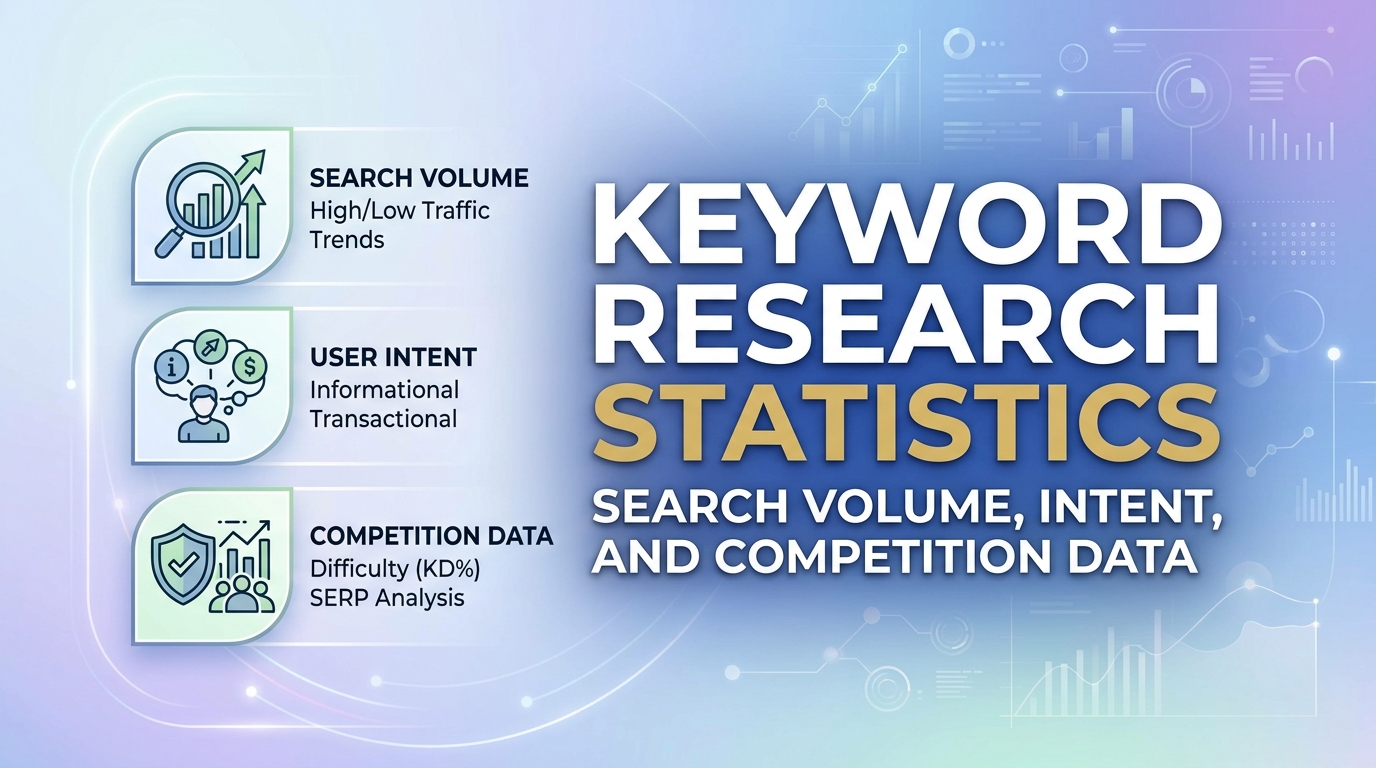
Keyword research in 2026 looks fundamentally different from what it was in 2022. The core activity — identifying what your audience searches for and mapping content to those searches — remains essential. But the context has changed dramatically: AI Overviews are reducing CTR for entire query categories, zero-click searches now account for 69% of all queries, 15% of daily Google searches have never been searched before, and the shift toward intent-first research (understanding why someone searches, not just what they search) has become the definitive competitive differentiator.
The brands winning in organic search in 2026 are not the ones targeting the highest-volume keywords. They are the ones who understand search intent deeply enough to create content that satisfies it completely — and who have the technical and topical authority to compete for the queries that actually convert. These statistics provide the data foundation for that kind of strategic keyword research.
The Search Landscape in 2026: Foundational Statistics
Understanding the context within which keyword research operates is the starting point:
-
Google holds 90.39% of global search engine market share across all devices
-
Google maintains a web index of approximately 400 billion documents
-
68% of online experiences begin with a search engine
-
63.41% of all US web traffic referrals come from Google
-
SEO drives 1,000%+ more traffic than organic social media
-
96.55% of all pages get zero search traffic from Google — the single most important number in keyword strategy
-
15% of all Google searches have never been searched before — reinforcing the long-tail opportunity
-
Google processes an estimated 8.5 billion searches per day
The 96.55% zero-traffic figure is not a counsel of despair — it is a strategic instruction. It tells you that the vast majority of content on the internet fails to match what searchers are actually looking for. Keyword research, done well, is the discipline of ensuring your content does not join that majority.
Keyword Volume and Distribution: Where the Searches Actually Are
The volume distribution of keywords is profoundly skewed — and understanding this skew is the most important structural insight in keyword strategy:
-
94.74% of all keywords get 10 or fewer monthly searches
-
0.0008% of keywords get more than 100,000 monthly searches
-
Long-tail keywords account for 91%+ of all web searches (Ringly.io / Embryo)
-
Long-tail keywords account for 65–70% of all search queries (multiple sources converge here)
-
Head terms (1–2 words) represent a tiny fraction of total search volume but command the majority of SEO competition
-
The top 3 organic Google results receive 68.7% of all clicks
-
The first organic result has an average CTR of 39.8%
-
Position 2 averages 5.82% CTR; Position 3 averages 3.11%
|
Keyword Volume Tier |
% of All Keywords |
CTR at Position 1 |
Competition Level |
|
100,000+ monthly searches |
0.0008% |
27–35% |
Extreme |
|
10,000–100,000 searches |
~0.5% |
30–40% |
Very High |
|
1,000–10,000 searches |
~4% |
35–45% |
High to Medium |
|
100–1,000 searches |
~20% |
40–50% |
Medium |
|
10–100 searches |
~30% |
45–55% |
Low |
|
1–10 searches |
~45% |
50–60% |
Very Low |
The counterintuitive reality revealed by this data: the keywords with the highest conversion potential (specific, intent-rich long-tail terms) are often the ones with the least competition and the highest CTR at position 1. The keyword research error most brands make is over-indexing on high-volume head terms that are expensive to rank for and convert poorly.
Search Intent Statistics: The Most Important Keyword Dimension
Intent — the reason behind a search — has become the primary organizing principle of effective keyword research in 2026. Google’s algorithms have become sophisticated enough to classify intent accurately, meaning content that mismatches intent (an informational article targeting a transactional query, for example) will not rank regardless of technical quality.
Intent Distribution in eCommerce:
-
70% of eCommerce searches are transactional in nature (clear purchase intent)
-
65% of all search queries are long-tail — typically indicating more specific, higher-intent needs
-
Commercial intent keywords have 1.8x higher CTR than informational queries
-
Long-tail keywords convert at 2.5x the rate of broad head terms
-
ChatGPT referral traffic converts 31% higher than non-branded organic search — AI-assisted searchers arrive with stronger intent
The four primary search intent categories and their SEO implications:
|
Intent Type |
Characteristics |
Content Match |
Conversion Potential |
|
Informational |
Learning/research |
Blog posts, guides, how-tos |
Low (awareness stage) |
|
Navigational |
Finding specific site |
Brand pages, homepages |
Moderate |
|
Commercial investigation |
Comparing options |
Reviews, comparisons, best-of lists |
High |
|
Transactional |
Ready to buy/act |
Product pages, landing pages |
Very High |
The most important shift in keyword research in 2026 is treating intent as a primary filter before considering search volume. A 500-search-per-month transactional keyword may drive more revenue than a 50,000-search-per-month informational keyword. Volume without intent matching is wasted targeting.
Keyword Competition and Difficulty Statistics
-
96.55% of pages get zero organic traffic — primarily because they target keywords they cannot compete for
-
Only 5.7% of newly published pages will rank in Google’s top 10 within a year
-
Only 1.74% of new pages reach the top 10 within one year for at least one keyword
-
72.9% of pages in Google’s top 10 are more than 3 years old — domain and content age is a significant competitive variable
-
Top-ranking pages for competitive terms have typically accumulated backlinks from hundreds to thousands of referring domains
-
Most top-ranking pages gain new referring domains at a pace of +5–14.5% per month — organic link acquisition is a competitive signal
Keyword Difficulty Benchmarks:
|
Keyword Difficulty Score |
Typical Characteristics |
Realistic Timeline to Rank |
|
0–20 (Very Low) |
Long-tail, niche queries, minimal competition |
1–3 months |
|
20–40 (Low) |
Moderate competition, some established content |
3–6 months |
|
40–60 (Medium) |
Established competition, links required |
6–12 months |
|
60–80 (High) |
Strong competition, authority required |
12–24 months |
|
80–100 (Very High) |
Dominated by major brands/publishers |
24+ months (if achievable) |
Google Keyword Planner and Search Volume Accuracy
Understanding the limitations of keyword volume data is essential for research methodology:
-
Google Ads Keyword Planner overestimates search volumes 54.28% of the time
-
It is roughly accurate approximately 45.22% of the time
-
46.08% of clicks in Google Search Console data go to hidden/not-provided terms
-
This hidden data means you are making keyword decisions without visibility into nearly half your actual click sources
The practical implication: keyword volume figures from any tool should be treated as directional signals rather than precise measurements. The relative ranking of volume (keyword A has more volume than keyword B) is generally reliable; the absolute numbers are not.
SERP Feature Statistics: Beyond Standard Blue Links
Modern keyword research must account for how different query types trigger different SERP features — many of which affect organic CTR significantly:
-
AI Overviews now appear for an estimated 86.8% of commercial searches
-
AI Overviews cause 58–61% lower CTR for organic results on affected queries
-
Zero-click searches account for 69% of all queries overall
-
Featured snippets achieve a 42.9% CTR — higher than standard position 1
-
30.9% of featured snippets come from pages ranking in position 1
-
61.5% of desktop searches and 34.4% of mobile searches result in no clicks
-
The top 3 organic results receive 68.7% of all clicks on non-zero-click queries
-
Rich results achieve 82% higher CTR than standard snippets
-
Being cited in an AI Overview generates 35% more organic clicks for that page
-
YouTube accounts for 23.3% of all Google AI Overview citations
SERP Features by Query Type:
|
Query Type |
Dominant SERP Feature |
Impact on Organic CTR |
|
Informational |
AI Overview + featured snippet |
-58% to -83% |
|
Local |
Map pack |
Significant diversion to maps |
|
Commercial |
Shopping ads + AI Overview |
Moderate to significant reduction |
|
Transactional |
Shopping ads + PLA |
Lower organic CTR for product queries |
|
Navigational |
Knowledge panel |
Usually benefit to target brand |
|
Question-based |
Featured snippet + PAA |
-30% to -50% |
Long-Tail Keyword Statistics: The Underutilized Opportunity
The long-tail remains the single most underutilized opportunity in keyword research for most brands:
-
91%+ of all web searches are long-tail queries
-
94.74% of keywords get 10 or fewer monthly searches (the extreme long-tail)
-
Long-tail keywords convert at 2.5x the rate of head terms
-
Long-tail keywords are significantly less competitive — achievable without massive domain authority
-
65% of eCommerce keyword queries are long-tail (3+ word phrases)
-
Someone searching “organic dog food for senior dogs” is many times more likely to convert than someone searching “dog food”
-
Seasonal keywords see interest spikes of up to 400% — timing content to seasonal long-tail demand is a significant opportunity
-
The average top-ranking page ranks for nearly 1,000 related keywords — comprehensive coverage of a topic area naturally captures long-tail volume
Keyword Research Tools: Performance and Accuracy Benchmarks
|
Tool |
Strength |
Accuracy |
Best For |
|
Google Search Console |
Real user data |
Highest (direct data) |
Monitoring actual performance |
|
Ahrefs |
Comprehensive database |
High |
Competitor research, difficulty |
|
Semrush |
Wide feature set |
High |
Full SEO workflow |
|
Google Keyword Planner |
Volume estimates |
Moderate (54% overestimate) |
PPC planning, directional volume |
|
Google Trends |
Trend direction |
High for trends |
Seasonal, trending topics |
|
SparkToro |
Audience research |
High for audience |
Understanding searcher profiles |
AI’s Impact on Keyword Research Strategy
The rise of AI search tools is creating new dimensions for keyword strategy:
-
34% of Gen Z now uses social platforms as their primary search engine — a meaningful diversion from Google
-
60% of US shoppers use AI tools for purchase research
-
Google still sends 345x more traffic than ChatGPT, Gemini, and Perplexity combined — traditional search remains dominant
-
ChatGPT accounts for 77.97% of all AI referral traffic globally
-
Perplexity drives 15.10% of AI referral traffic
-
AI-cited content is 25.7% fresher on average than organically ranking content — freshness signals are increasingly important
-
74% of all new web content now contains AI-generated content — increasing competition for every keyword
The practical keyword research response to AI search: prioritize EEAT (Experience, Expertise, Authoritativeness, Trustworthiness) signals in content creation, optimize for featured snippet capture, build comprehensive topic coverage that positions you as a citeable authority, and maintain content freshness — particularly for time-sensitive queries.
FAQs
Long-tail keywords matter more than ever in 2026, making up over 91% of all searches and converting 2.5x higher than head terms. AI Overviews primarily disrupt informational head terms, leaving transactional and commercial-intent long-tail queries largely unaffected, making them a safer and more profitable targeting strategy.
Google Keyword Planner overestimates search volumes 54.28% of the time, so treat volume figures as directional signals rather than exact predictions. For the most reliable data, cross-reference tool estimates with Google Search Console, which provides real click and impression data for keywords you already rank for.
Search intent is the single most important factor in keyword selection in 2026. A 500-search transactional keyword that aligns precisely with buyer intent will typically generate far more revenue than a 50,000-search informational term that rarely leads to a conversion.
With 69% of all searches now ending without a click, informational queries have significantly lower traffic value than their search volumes suggest. Savvy SEOs are shifting focus toward commercial and transactional intent keywords where users must click through to complete their goal, and optimizing for featured snippets which achieve a 42.9% CTR.
Only 1.74% of newly published pages reach Google’s top 10 within one year, and 72.9% of pages currently ranking in the top 10 are over three years old. Targeting low-competition long-tail keywords offers the fastest path to ranking, with realistic timelines of one to three months compared to 12 to 24 or more months for high-competition head terms.



