



I’m still working on pouring all the faux concrete pavers for the base area of the porch. When I left you on Friday, my plan was to set up all of my molds that I had made for the fake bricks in the carport, start mixing the concrete, and basically run the assembly line all day Saturday so I could make as many bricks as possible. But then I realized I had skipped a crucial step. I had no idea exactly how many bricks I needed to complete the baseboard. And to find out, I had to design the design before I started pouring the concrete.
My first thought was that I could use ChatGPT to create this design map of my stones. I had eight different shapes and all eight were different sizes, and I was sure ChatGPT could do this much faster and better than I could. I mean, AI is much smarter than me. So I went to ChatGPT and gave it this prompt:
I’m working on a porch project. The base area (i.e. the front and side vertical part) is made of solid concrete and I want to glue an artificial stone to the base area.
The area to be covered is 13.5 inches high. The front of the porch that needs to be covered is 154.5 inches wide, and on the far right there is a 90 degree outside corner, and the side base area of the porch is another 60 inches wide.
I have eight different sizes of faux stones that I will use to cover this area. The stones have the following dimensions:
- 5″ high x 24″ wide
- 2″ high x 16″ wide
- 5″ high x 15″ wide
- 7.5″ high x 15″ wide
- 5″ high x 20.5″ wide
- 2.5″ high x 7.75″ wide
- 7.5″ high x 15.5″ wide
- 5″ high x 16″ wide
Between the bricks I want to leave 1/2 inch for mortar lines. However, I don’t need mortar lines below the bottom row of bricks or above the top row of bricks. I also don’t need mortar lines on the far left side of the assembly at the front of the porch skirting (i.e. where the bricks meet the porch steps). At the outside 90 degree corner, I want my 3/4″ thick stone siding to look like full stones, so I want a consistency from the far right at the front of the baseboard to the far left in the baseboard area on the side of the porch.
I don’t mind cutting up the stones, but I want the vast majority of the stones to be used whole.
Based on all of this information, please create two diagrams – one for the base area at the front of the porch and one for the base area at the side of the porch – and arrange the stones in the available sizes to achieve the most random arrangement possible without obvious repetitions in the arrangement.
I will be casting these faux concrete blocks myself using molds I built. Therefore, in the diagram you will need to use the numbers for each size that I listed above to show me where to place each brick and so that I know how many of each size brick to make.
I was pretty excited to see what would come out of it, and I was also confident that it could produce a much better design than I could. The images took quite a while to create, so I left my computer for a while and came back later, excited to see the amazing design he had created for me.
Imagine my disappointment when I saw this…
Yes. That’s awful. There is nothing “random” about the placement of these stones. I could have done this in the same time it took ChatGPT to do it. But this was exactly the type of design I wanted to avoid.
And not surprisingly, the same design was continued on the side of the porch.
There is no way I would arrange the bricks in this pattern when the real bricks in the rest of the house are arranged in a really random pattern. Well, obviously they’re not random. A lot of thought and planning went into it. But the arrangement is not predictable or in an obviously recognizable and repeating pattern…
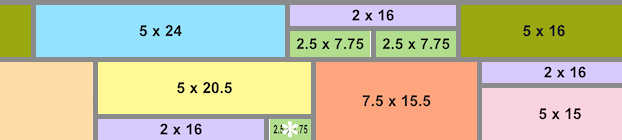
Since ChatGPT completely failed me, I had to come up with my own design. I created an image of each stone with the correct dimensions using my photo editing software and then copied and pasted each of those images into a larger image that I had created to represent the exact dimensions of the base area of the porch.
As I explained in my ChatGPT prompt, I wanted to use as many whole bricks as possible, but was okay with cutting a few of them to fit. This is the agreement I came up with. The stones with the little white stars on them need to be cut to fit.
And then this is the design I did for the side of the porch.
So the plan is to finish off the right corner of the porch with two stones (the green and the light orange stone) cut at a 90 degree angle, then wrap those around the side of the porch to create the full stone look, and then continue with the rest of the design.
And to test the design and make sure the proportions were right, I copied and pasted the map into an actual image of the base area of the porch. It looks like I did it right!
I won’t lie. This was a very time consuming process. I had to consider not only the size of the bricks, but also the 1/2 inch mortar lines to make sure I covered every square inch of the base surface. But with these two cards in hand (I still need to make one for the small area to the left of the porch steps) I knew exactly how many of each stone I needed. I was a little shocked when I saw how little of the larger stones I needed. If I had just set up my assembly line and started pouring concrete, I would have ended up with way too many of the big rocks and way too few of the small rocks, and I would have wasted a whole lot of concrete and time.
The actual concreting process went smoothly. I set all the shapes up on a folding table in the carport and made sure they were all level. And then I mixed the concrete in small batches – just two liters of concrete and half a liter of water at a time – and worked as quickly as I could, batch by batch, until all the molds were filled. And then I watched over the molds for a while, spraying them with water when the concrete got really hot so they wouldn’t crack as they hardened.
The demoulding process was the most time consuming part of the entire process. Because these bricks are so textured, I had to remove one side of each shape to pry each brick out. Then I had to reassemble the mold, reset the sand under the textured silicone mat, and reseal the mold to prepare it for the next pour.
I actually didn’t get very far with the concrete. I had finished my first batch, was preparing the molds for the next cast, and then Matt needed my help with something that took quite a bit of time. When I was ready to go outside for the next watering, it was pouring rain. I mean, it was pouring so hard that everything under the carport got wet, including my bags of concrete. So instead of pouring more concrete, I had to spend all the time I had left moving concrete and tools to protect them from the rain. And of course, the area where I had set up my table with the molds was hit by the rain, as were my concrete blocks that I had placed on the ramp to the workshop.
So I was derailed by the rain once again. It’s mid-June. In Central Texas. The rain should have stopped by now and we should have 30 degrees Celsius and only sunshine. This rainy weather is starting to really frustrate me. I haven’t even glanced at the weather forecast for this week, but I’m really hoping it doesn’t rain during my week (which is supposed to be my last week working on outdoor projects)!! I will be so disappointed if that happens. But there’s not much I can do about it, right? I may need to be flexible this week and come back to this project at a later date.



