



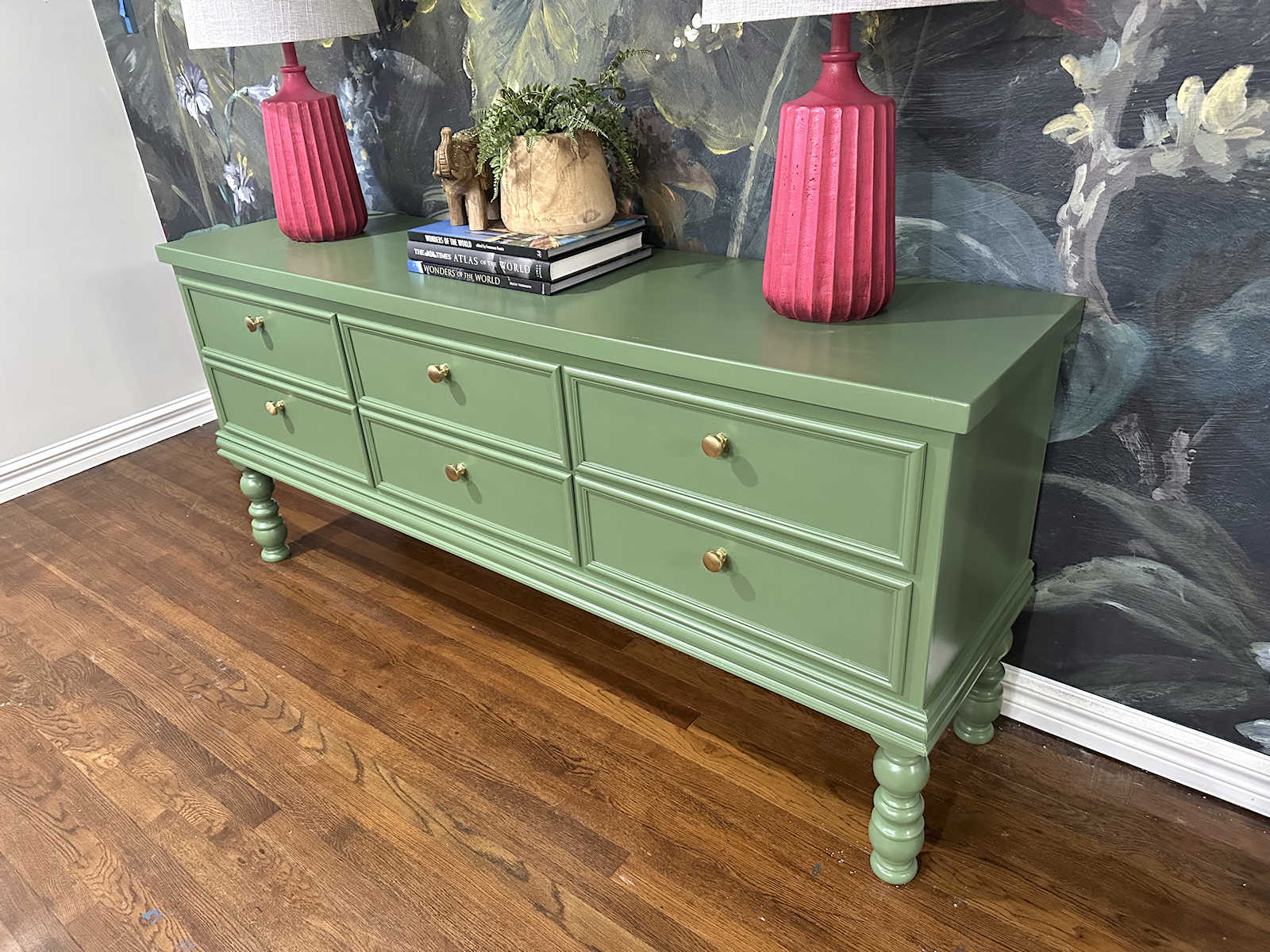
The makeover of my entryway console table is finally complete! I already know opinions will be divided on this, but I ended up painting the console table instead of trying to use a gel stain to get a natural wood finish. After looking around the living room and music room (i.e. the two adjacent areas), I realized that I already have a lot of natural wood finishes in these areas and have a preference for painted finishes. So I decided to give it a try.
I chose a dark green called Scallion from Behr. I chose green over pink for two reasons. First, I had already spent some time refinishing my lamps with faux pastels (you can read more about that here), and it took a while to get exactly the color I wanted. I wasn’t ready to repaint these. But the main reason is that when I stepped back and looked at the entire area, I realized that a large pink piece of furniture in the entryway would likely be competing for attention with the raspberry-colored sofa in the music room, and both are clearly visible as soon as you enter the front door of our house. So green was the color.
For some reason the colors of both the console table and the lamps appear brighter in the pictures. They’re both a bit darker in person. But anyway, here is the end result.
I’ll be adding some more accessories and finishing touches to the area, but at least the main parts are finally finished.
Let me look back and remind you where this all started. This is what the console table looked like before it was redesigned. I know many of you really loved the natural wood finish, but the finish really bothered me. It may look good in the pictures, but in person it was way too orange and blotchy for my taste. I lived with it for so long and finally decided I didn’t want to live with that streaky, patchy finish anymore.
Since I wanted to redesign it anyway, I decided to follow the advice of some of you and remove the bottom shelf. After removing the shelf I was left with four turned legs, each consisting of two pieces.
I glued and nailed these together and then filled the gap where the two pieces met with wood filler.
And then I had to add a block to the top so I could securely attach the legs to the top of the console table. Using a hand saw, I cut off the top twisted portion of each leg.
And then I used the top smooth end of this twisted section to trace a circle on the blocks, which I made by gluing and nailing four 2×2 blocks together.
This is what it looked like with the circle drawn on top of the block.
Next, using my orbital sander and an 80 grit sanding wheel, I sanded the corners at an angle until I reached the edge of the drawn circle.
This is what it looked like from the side…
After sanding the corners, I started sanding all the way around, keeping the same angle with my sander until the whole thing was sanded to reach the edges of the circle.
And then I sanded in a bit more detail to round off the bottom corners and blend them with the side edges of the block.
After sanding them, I attached these blocks to the legs using wood glue and 18 gauge 1.5 inch nails. (The block shown here was not fully sanded and is not yet properly attached.)
After completing my new Frankenstein legs, I attached them to the bottom of the console table from each side using lots of wood glue and a few 16-gauge 2-inch nails.
Once all four were attached, I left them alone for a while to allow the wood glue to dry.
Next I cut 2×2 pieces of wood and attached them between the legs. I didn’t have enough 2×2 lumber on hand to cover the entire span between the back legs, so I just used smaller pieces and made sure they fit tightly to the block on the back legs. I attached these 2×2 pieces of wood using lots of wood glue and then 2.5 inch 16 gauge nails to secure them to the bottom of the console table.
And finally, I used 2.5″ wood screws and angled them so they went through the 2×2 wood and into the sides of the blocks on the legs.
I was going to use my Kreg pocket hole jig for this, but when I was trying to set the drill to the correct depth, I accidentally screwed the small screw on the collar of the drill out too far and it came all the way out. And then it fell on the floor and I couldn’t find it. So I had to forgo my handy Kreg pocket hole jig and just angle the screws in without those neat pocket holes. It worked out well in the end, but it would have been much easier with pocket holes. Drilling pocket holes minimizes the risk (there is virtually no risk) that the screw will split the wood as it is screwed in.
This is what it looked like when it was erected. I definitely like it better without the shelf, and as I’ve already learned, it’s much easier to clean under the console table without the low shelf in the way. But I still had to cover the edges with decorative strips.
I forgot to take a photo of the trim before I painted the console table, but I found some 2 1/4 inch molding at Lowe’s that attached perfectly to the bottom and covered the 2×2 wood as well as the area where those 2x2s met the bottom of the console table.
Now that everything is said and done, I’m really glad I took the time to remove the bottom shelf. I really like the more open look. And as I said, cleaning under the console table is now much easier.
I swapped out the ring handles for some very simple large gold buttons. I was ready for a change there too. I like the simplicity of it.
I’m not exactly happy with the items currently sitting in the middle of the console table, but I had them on hand so I put them there for now. I’ll see what else I can think of. Or maybe I won’t. I’m not sure yet. But I have some ideas for the areas on each side of the console table. I think these areas need something.
I’m glad I finally did this and I’m really glad I found a way to keep the twisted legs. I don’t think I would have been happy with the simple, straight legs I had previously considered. And now that that’s done, I still need to get some accessories, put away all my tools, and get the living room back in order. And then I’ll show you the entire area with the new look of the entrance wall.



