



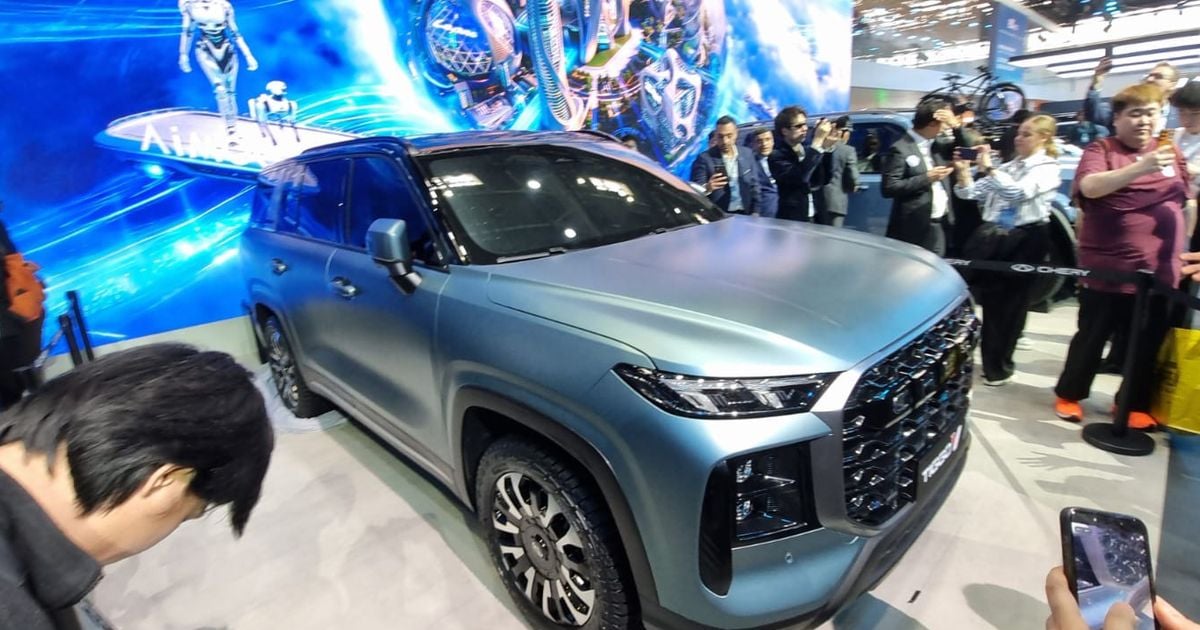
The 2026 Chery Tiggo V was unveiled at the Beijing Motor Show, previewing a bold new direction for family SUVs and a potential niche player in the Australian and New Zealand automotive markets.
Touted as “a vehicle for all scenarios,” the Tiggo V combines the functionality of a large seven-seat SUV with the flexibility of a small car thanks to a unique modular design. Like the Deepal E07, its standout feature is the ability to transform from a three-row SUV to a double cab-like layout.
By removing the rear canopy and third row of seats, owners can create an open cargo area separated from the cabin by a bulkhead. Chery says up to six configurations will be available, including lifestyle-oriented configurations such as an RV conversion or an enclosed cargo module.
With Daily Sparkz you can save thousands on a new car. Click Here to get a great deal.
This adaptability is aimed squarely at buyers who want the comfort and refinement of a family SUV for everyday use, but also the added versatility for hauling larger loads when necessary.
However, expectations should be tempered. The Tiggo V is unlikely to be able to match the payload or towing capacity of traditional ladder-frame trucks, making it more of a lifestyle alternative than a true workhorse.
Unlike dual-cab models such as the Ford Ranger and Toyota HiLux, the Tiggo V rides on a car-style monocoque platform that prioritizes on-road comfort and refinement over heavy-duty capability.
In terms of size, the Tiggo V measures over five meters in length and rides on a 2800mm wheelbase. This makes it slightly larger than the large Chery Tiggo 9 SUV, but still shorter than most double cabs.
Inside, buyers can choose between six- and seven-seat configurations, including a more premium 2+2+2 seating configuration with second-row captain’s chairs.
The interior follows Chery’s latest design language, with two digital displays, physical button combinations and a focus on family-friendly features, including independent second-row seats with 380mm sliding adjustment and no fewer than 42 storage spaces.
These include a rear-mounted refrigerator, third-row air vents, and a 360-degree camera system with an “underfloor” view to help with low-speed maneuvering.
Under the hood, Chery is expected to offer a mix of gasoline and electric powertrains. A sixth-generation Chery Super Hybrid (CSH) plug-in hybrid (PHEV) combines a 1.5-liter turbocharged gasoline engine with electric motors and a battery, providing approximately 90-100 km of pure electric driving.
The total output of the system is expected to range from around 160kW of power up to 260kW and 330Nm of torque in higher spec variants. A conventional 2.0-litre turbo petrol engine is also sold in some markets.
The PHEV version is said to offer an average fuel consumption of 6.0L/100km and the petrol-only variant is said to consume 7.84L/100km.
Despite its road-focused underpinnings, the Tiggo V offers respectable off-road capability, including a ground clearance of 220mm and a fording depth of up to 700mm for PHEV variants. This makes it more like a soft-road vehicle than a hardcore off-road vehicle, but it should also be suitable for gravel roads and other light off-road adventures.
Production is expected to begin in China later this year, but local availability for Australia and New Zealand remains unconfirmed.
Chery’s local arm has already expressed interest in the concept, particularly as a lifestyle-focused addition to its upcoming ladder-frame crew cab vehicle, which is due to arrive Down Under in the fourth quarter of this year with plug-in hybrid diesel power.
If it makes it to right-hand drive markets, the Tiggo V could carve out a unique space in the new car market, where it would likely be positioned above the Tiggo 9, available here in a single all-wheel-drive PHEV variant priced from $59,990 before on-road costs.
MORE: Explore the Chery showroom



