



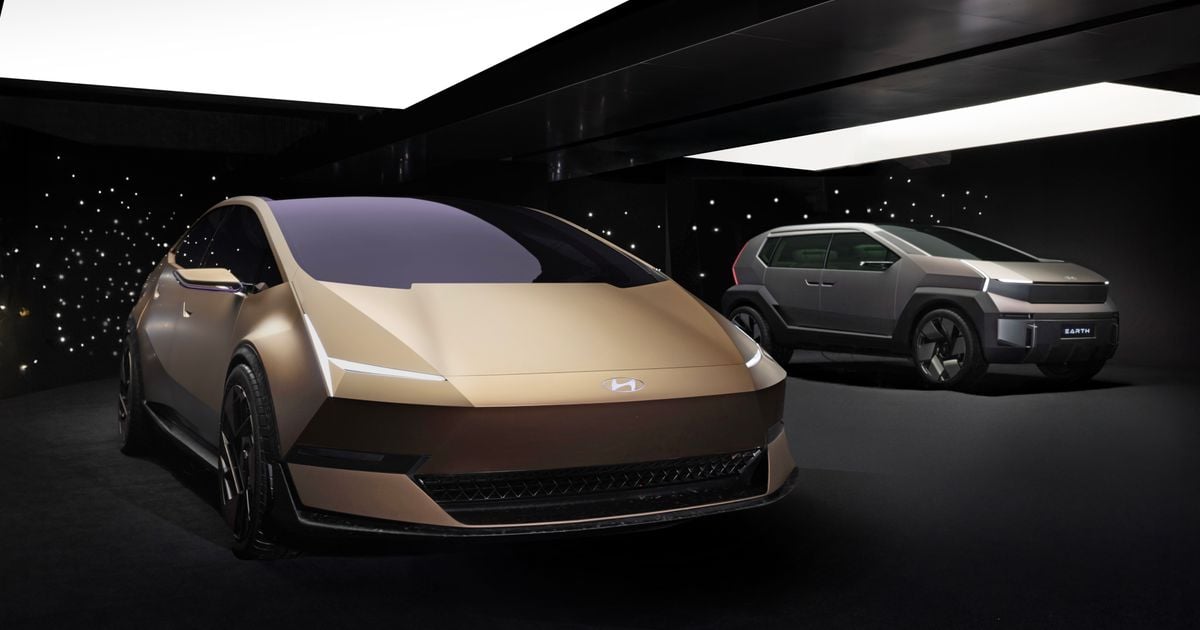
Hyundai is preparing for a major overhaul of its electric vehicle (EV) strategy in China, led by the official local launch of its EV sub-brand Ioniq and previewing two radical concepts.
The Venus sedan and Earth SUV are two China-specific concepts that represent a drastic departure from Hyundai’s established electric vehicles sold elsewhere and are said to embody a new “lead, don’t follow” strategy for the Korean brand’s Chinese electric vehicle efforts.
Part of this is a new naming convention. Instead of adopting similar nameplates to its current EV models – such as the Ioniq 5, Ioniq 6 and Ioniq 9 – Hyundai will name its new model range after planets, in a nod to “a universe that puts the customer at its heart”.
The concepts also differ visually from existing Ioniq models and deviate from the pixel-heavy retro look of the Ioniq 5.
With Daily Sparkz you can save thousands on a new car. Click Here to get a great deal.
At the heart of the Venus concept is a “sleek single-curve profile” that combines the hood, cabin and trunk in a single smooth arc. It’s significantly different from Hyundai’s current electric sedan, the Ioniq 6, which is far curvier than the boxy concept.
The Venus concept is finished in bright gold in honor of the planet it is named after and features a “lightweight roof structure” and a transparent spoiler. Inside is a “driver-focused interior” with layered mood lighting, “high-quality materials” and a screen that stretches almost the entire width of the vehicle.
The Earth, on the other hand, is much more robust on the outside, but retains the angular design and slim headlight elements. With pronounced body cladding and far sturdier pieces on the front and rear bumpers, Hyundai seems to be looking for a more adventurous, outdoorsy vibe.
Its interior is just as radical as the Venus’s, but forgoes the monolithic dashboard-mounted screen in favor of “air-hug” seats, “nature-inspired lighting” and “subtle shy-tech features” to create a “comfortable and breathable” space.
Not much else is currently known about these two concepts, including the platform on which they will be built. It’s unclear whether they will use a new EV architecture that is separate from Hyundai’s E-GMP framework, which underpins most of the current electric range.
It’s also unclear whether Hyundai plans to roll out its new China-focused range of electric vehicles globally, but there are some indications that this could be the case. One of these is its stated goal of “In China, for China, globally,” which could indicate global expansion of either these new models or at least its latest technology.
Hyundai’s recently launched Elexio electric SUV will be built in China through Hyundai’s joint venture with BAIC Motor and exported to global markets such as Australia.
The Beijing Hyundai joint venture has already been responsible for several models in the Chinese market, and it is possible that Hyundai could use it to expand the global presence of these future electric vehicles.
The launch of Hyundai’s Ioniq electric car sub-brand in China will be the most significant boost to electric vehicle sales there yet. Although the company offers a wide range of electric vehicles worldwide, it has been slow to gain a foothold in the Chinese market.
Aside from the new Elexio, the company has only built and sold a handful of electric vehicles in China so far, including the now-defunct Lafesta EV sedan. The Ioniq 5 N is imported and is therefore subject to significant import duties, while the regular Ioniq 5, Ioniq 6 and Ioniq 9 models are not available.
The Beijing-based Hyundai joint venture sold over a million vehicles in China each year between 2013 and 2016, before sales fell to 755,659 units in 2017. While they rose slightly in 2018, the downward trend subsequently continued and culminated in just 125,726 sales in 2025 – the worst value in around 20 years.
This decline in sales is not entirely due to a lack of suitable models for the Chinese market, as the Chinese government also retaliated against brands from Korea after the country deployed a US-made missile defense system in 2017.
Hyundai’s announcement is in line with other brands’ recent plans to make concerted efforts on Chinese electric vehicles. Sister brand Kia’s EV5, for example, is a Chinese-built electric vehicle related to the Elexio that is also exported overseas.
Volkswagen is also involved in several partnerships with Chinese brands and has thereby developed several electric and combustion engine models for the Chinese market. It was also ahead of Hyundai in laying out its “In China, for China” strategy.
Audi, a sister brand of the Volkswagen Group, has also launched a China-specific electric vehicle brand, confusingly named AUDI, in collaboration with MG owner SAIC Motor. The group is now Skoda is withdrawing from China after a sustained decline in sales as the Czech brand never launched any of its electric vehicles there.
Japanese brands such as Nissan and Toyota have also invested in developing China-specific electric vehicles with their joint venture partners, with some such as Mazda also exporting such vehicles widely to global markets such as Europe and Australia.
MORE: Explore the Hyundai showroom



