



I’ve been really struggling lately to come up with a cohesive plan for all the steps I need to build (and have already built) that is visible on the front of our house. As you know, a few years ago I built the steps to our porch using pressure treated lumber, PVC panels, and cedar porch boards.
And while the porch, steps, and fascia boards were all done at the time (some repairs are currently underway), I was really struggling with covering the rest of the concrete on the porch, the portion that would be considered the porch baseboard.
I tried AirStone, which somehow matched the Austin stone already on our house, but I never finished it. And because it sat there for so long without being sealed, it started to crumble. Then a few days ago I tried covering it with PVC panels, but I had problems with that too. And then I came up with the idea of covering it with a mortar mix and using the mortar mix to create my own faux stone or brick look.
But before embarking on this project, I spent some time imagining how the porch with the stone or brick baseboard would fit with the steps I still need to build for the side door of my studio and our new bedroom door, since all three areas are visible from the front of our house. They all have to coordinate somehow.
Up until two days ago, I was planning on building wooden steps in the other two areas to match the steps leading up to our porch – white PVC walkway boards with stained wood porch boards. But as I said, this plan raised other problems. Right now the porch is cedar. It is real wood and needs to be sealed regularly. So if I had chosen the same design for the other two areas, my choice would be to (1) continue to use cedar porch boards, which require periodic sealing, or (2) change course now and use composite porch boards for the two new areas and create a plan to replace the cedar porch boards on the front with composite so that all three areas match.
That was such a struggle for me. I just don’t want to have more areas of cedar steps that need regular maintenance, but I also didn’t want to spend the time or money replacing the porch. Not now. And hopefully never. I really want to invest that time and money into other projects, and a quick re-sealing of the porch every two years or so is actually pretty doable. I just don’t want more of it in two other areas.
So I racked my brain and tried to come up with a different plan for the other two areas that would work with the porch without having to look like the porch. That’s why I spend so much time on YouTube every night to find inspiration.
And two days ago I came across exactly that. I found this channel called Michael Builds and watched a few of his videos because he is extremely entertaining and very talented. And as I scrolled through his videos, I noticed one in which he builds “quick and easy concrete steps.”
Right off the bat, I absolutely loved the look of these steps. And concrete steps would be much better and more durable than wooden steps. So I watched the video about three times in the last two days and came to the conclusion that it is exactly what I want for the other two areas.
But of course there is a big problem. He actually builds molds and casts the steps himself, and when they are dry he takes them out of the molds and puts them in place. This is a great project for a strong man. However, I am not a strong man who can install large concrete steps on my own. Also, my steps need to be much larger (wider and much deeper) than the ones he cast.
I spent quite a while deciding whether I should tackle pouring my own very large concrete steps and wondering if I could get enough strong men to put my steps in place for me. But then I wondered if I could use concrete pavers instead of solid concrete steps. I can’t lift a solid concrete step on my own, but I can certainly work with concrete pavers.
After doing a fair amount of calculations and fleshing out and fleshing out my idea, I went to Home Depot to see what they had. For my side studio door I want to have three steps from the driveway to the door and I want the top step to have a 30 inch landing. And if I make each step 5.5 inches high, it will be the perfect height. And I found exactly what I needed.
After spending all of yesterday doing math, math, drawing, and shopping, I didn’t really have much time for actual work before it got too dark to work and too late to make much noise. But I had about an hour and a half to create a preliminary draft of my idea and see if this would actually work. And I think it will!
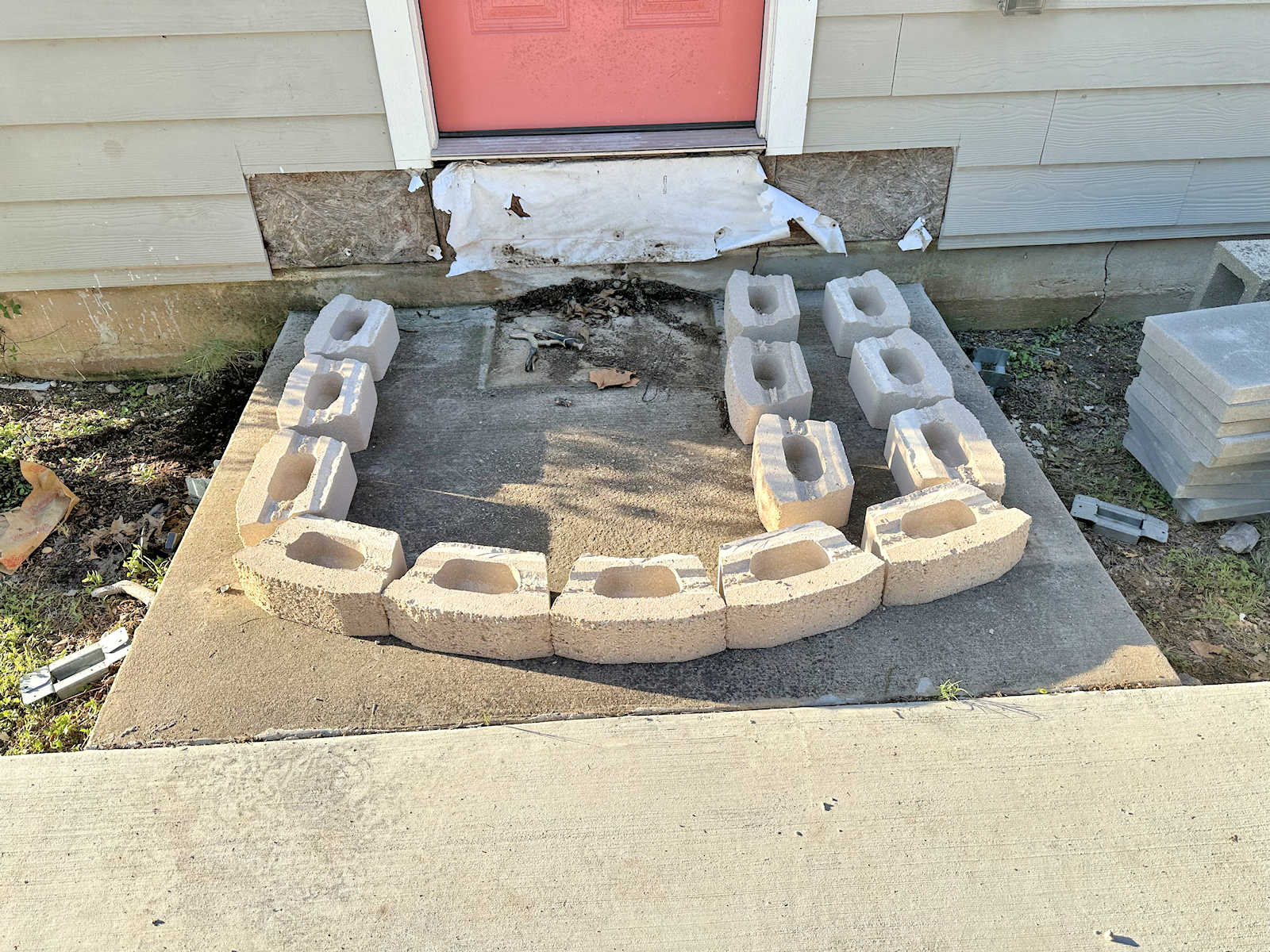
The shape still needs a little tweaking as I want the bottom step to stick out enough to end right where that concrete slab meets the driveway. However, the idea is to lay out these four inch high retaining wall blocks so that they are straight on the sides but rounded on the front. And then I add more retaining wall blocks within this shape to create the structural support for the steps.
And yes, I still need to figure out what I’m going to do with the exposed OSB before I actually start officially building these steps. This was cut out when the trim was installed and when the plan was to build wooden steps to match the porch steps. The steps to the house would have been attached there. But now that plans have changed, I need to figure out how to cover up this area.
Anyway, to get the corners to fit together, I need to cut the two retaining wall blocks on the front at each end, and then the side block can fit snugly against them.
And once that’s done and all the blocks are attached with masonry adhesive, I add the pavers to form the step. In the photo below they look uneven because the retaining wall blocks have a lip that needs to be cut off before the pavers can lay flat, and I didn’t have enough time to cut them all off before it got too dark and late to work.
But hopefully you can see the vision here. Remember that these two corner blocks actually meet when I cut them to fit together. This unsightly gap will not be there.
And once I have all the interior support blocks in place (with the lip cut off of all of them that prevents the pavers from laying flat now), I’ll cover the whole thing with the pavers.
And then I come back with my hand sander with a masonry disc and cut off the curve at the front.
So this is the plan for this door as well as our new bedroom door. These steps and the bedroom door steps match. And then these steps just need to be coordinated with the porch. I’m still trying to figure out exactly how to do this (I’m thinking about a few options), but the end goal will be to get the stone facade baseboards to match the look of the retaining wall block steps on those steps. This connects the three areas so that they are all coordinated. They won’t match, but I’m okay with that as long as they all coordinate and look cohesive. And really, I love the idea of the porch being the only area that has the stained wood porch boards because not only does it prevent me from having even more wood in those other two areas that need regular maintenance, but it also ensures that the porch remains the main focus of the front of our house.
I’m honestly so excited to finally have a plan. I think it will be very pretty when all of these areas are finished. And maybe I’m being a little overconfident and optimistic, but I really think these steps won’t be too difficult. I think it will be much easier than building wooden steps! The hardest part will be getting the initial shape for the lower stage perfect. Once that’s done, I think the other two steps will go very quickly.



