



I spent yesterday trying to figure out the best way to pour my faux concrete “bricks” for the porch baseboard. This is my first time working with concrete, so I was a little unsure about my plan. But I had watched a lot of videos about making molds and pouring concrete and felt ready to move on.
If you’ve been following along, you know that I got as far as making my own textured silicone mats from the actual bricks on the front of our house, and then converting those silicone mats into molds that I could use to cast my own concrete bricks for the baseboard.
I tried three times before I succeeded. So let me tell you about the failures and the mistakes before I show you the success.
Test #1 – Aircrete Artificial Bricks with Fast-Setting Concrete – Fail
I was so focused on this process that I forgot to photograph this first attempt. But my original idea was to make my own aerated concrete (which is about 50% lighter than concrete) to make my bricks. I came across this very helpful video that shows a very simple recipe for homemade aerated concrete using items you probably have in your kitchen (especially if you’ve ever been on a ketogenic diet).
My only problem with the process he shares is that he uses plain Portland cement to make the aerated concrete and Portland cement takes a long time to cure. I was hoping to find a way to make aerated concrete with a quick-drying concrete formula instead of the very slow-curing Portland cement, so that I could do multiple pours in a day with each of my six molds.
Before I tested this, I left a comment on this video asking if he thought it would work. He seems to know a lot about chemistry, while I know very little about the subject. I wasn’t sure if the additional ingredients in a quick drying formula would negatively impact or counteract the aerated concrete formula. He actually responded within minutes and said that he thought it might work as long as there was no additive in the quick-drying mix.
Unfortunately, as far as I can tell, there is no quick-drying cement mix without additives. The closest thing I could find at my local hardware store is Rapid Set Cement All, which uses a superfine sand as an aggregate. So I decided to give it a try.
When mixed with water according to instructions, Rapid Set Cement All will set within 15 minutes and is expected to harden in about an hour. But here too it is mixed with plain water. But I tried it mixed with the aerated concrete liquid formula from the video.
It didn’t work. Or I think it would be more accurate to say that it probably would have worked if I had given it more time to cure, but after I gave it two hours to dry, it had only reached the consistency of solid, wet beach sand, kind of like the consistency you’d want to build a sandcastle on the beach. So the aerated concrete liquid formula definitely negated the rapid curing feature of the Rapid Set Cement All, and that’s exactly the feature I needed.
So at this point I still had two options. I could use the exact AAC formula with plain Portland cement, which would allow me to cast six bricks per day, or I could just use Rapid Set Cement All and mix according to the instructions (i.e. with plain water) and be able to cast multiple bricks per mold per day. I chose the second option.
Test #2 – Rapid Set Cement Any with a textured backing – FAIL
For my next attempt, I followed the instructions for mixing the Rapid Set Cement All, which is about one part water to four parts Cement All. I mixed it in a very small amount, just enough to fill my mold, and then poured it into the mold. It started to cure very quickly (in less than 10 minutes) so I was very hopeful.
But since I knew I would be gluing these faux stones to the base area of my porch, I thought adding some texture to the back of the stone might improve adhesion. I did this with my utility knife, barely skimming the blade across the concrete surface.
That was ultimately a mistake. And then I made another rookie mistake because I’ve never worked with concrete before. I gave him the hour specified in the instructions and it felt very hard. But I noticed that it also still felt very hot, meaning the chemical reaction that hardens the concrete was still happening. But I was scared, so I ignored it and tried to unmold the stone.
When I removed the stone from the mold, it broke into two pieces along the line indicated by the arrow below.
Since it was ruined, I decided to test the strength of the Cement All at this point, so I picked up the two large pieces and dropped them on the concrete and it continued to crack. From the front it looked like random fractures.
But these weren’t random breaks. When I turned the pieces over, I could see that the breaks on the back were exactly along the texture lines I had made on the back.
You can see here that I didn’t even make these texture lines very deep, but they definitely compromised the integrity of the concrete.
So this was a very helpful test and a very important learning experience for a concrete newbie like me. The first important lesson is that you should never remove concrete from a mold when it is still hot to the touch, even if you have waited as long as the instructions say. As long as it is still hot, the concrete will still harden. You must wait for the heat to completely dissipate before removing it from the mold. The second important lesson is that you shouldn’t mess with the backing, probably especially not with something as thin as 3/4″ faux stones.
With my new knowledge from this second failed attempt, I was ready to try a third time.
Test #3 – Rapid Set Cement All – SUCCESSFUL!
Here too I mixed a very small amount of Cement All and poured it into my mold. And by the way, before I poured the concrete into the mold, I sprayed the mold with WD-40 to act as a mold release agent. And this time I left the back alone.
And this time I waited until it not only felt really hard, but it also felt cool. I’m not sure how long that took because I was busy with something else. I would estimate it took about an hour and a half to two hours. I then removed the small end piece of my mold and removed the stone.
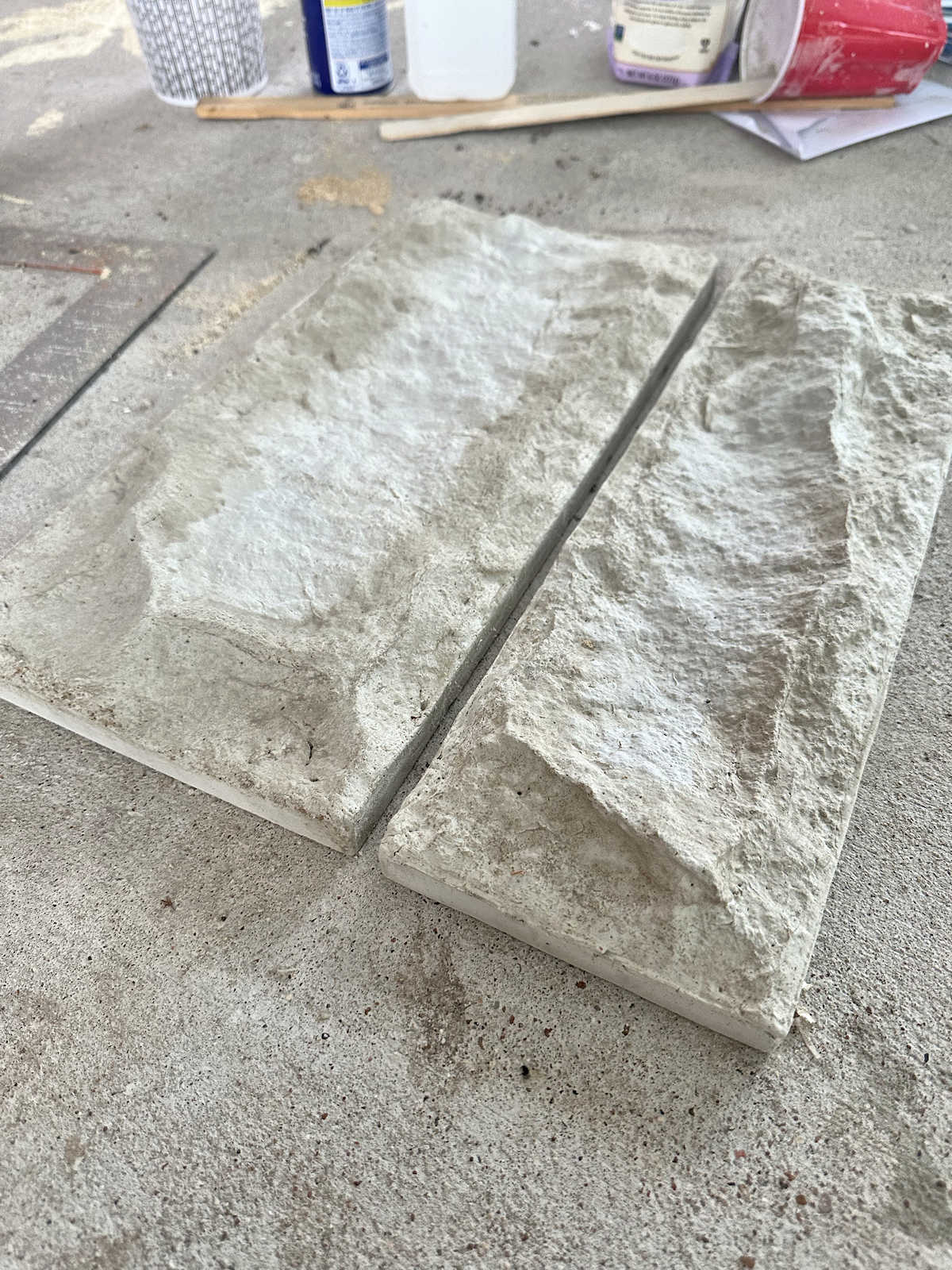
That was a success! For this test I used two of my molds and cast two bricks and both turned out great. I believe the WD-40 caused some discoloration, but since I will be priming and painting these bricks, I’m not worried about the color at all.
I was so excited when I took these two stones out of their molds and saw the finished result.
Other than the color, they looked like they would perfectly match the stone on the front of our house.
Due to the discoloration it is somewhat difficult to get a good, accurate picture of the stones. Maybe you just have to take my word for it. They look so good!
Now that I’ve completed my process, I need to set up an assembly line in my carport with all six molds so I can pour six at once every two hours.
I have another week to work on outdoor projects before I turn to the storage closet in our bedroom suite. I really hope I can finish the porch in this time!



