



-
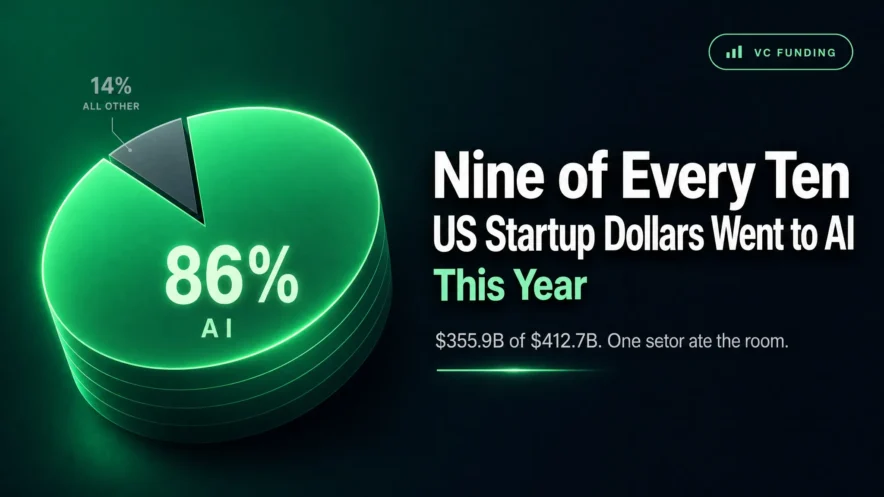
US startups raised $412.7 billion in the first half of 2026.
-
Of this, around $355.9 billion, or 86 percent, went to AI companies.
-
Everything else, from biotech to consumer apps, shared the remaining 14 percent.
Record funding years used to mean many founders got paid. In 2026, that means a handful have made it.
The concentration that no one planned
In the first half of 2026, US startups raised $412.7 billion, and an impressive 86 percent of that, about $355.9 billion, went to AI companies. This is the highest concentration the world of startup funding has ever seen.
Sit with the leftovers for a second. Biotech, climate, fintech, consumer apps, developer tools, marketplaces, hardware and every non-AI category collectively fought for about $57 billion. In a normal year that would be a decent yield. In a year in which one sector took in $355.9 billion, it looks like a rounding error.
The shape of the boom is more important than the size. In past cycles, a record funding year meant that many different companies received money. This time, a record year means a small group of AI giants absorbed almost everything while other founders watched the space empty out.
What it means if you don’t develop AI
There are three practical consequences, none of which are hypothetical.
Valuations outside of AI are becoming increasingly difficult to defend. If a partner can invest $500 million in a model lab at a headline-grabbing premium, your $8 million for a solid non-AI company is competing for attention it won’t get.
Talent pricing is broken. Engineers who would have joined a fintech company in 2023 are now receiving offers from labs with virtually unlimited budgets. Salary benchmarks in adjacent industries are being pulled up by companies that don’t care about the benchmark.
And the exit math has changed. When capital is so concentrated, buyers become concentrated too. Fewer buyers, fewer bidders, worse conditions for founders who sell everything that is not an AI asset.
There is a fair counterpoint worth including. Some of that $355.9 billion isn’t really venture capital in the traditional sense. It’s infrastructure spending dressed up as equity, money that goes directly into chips, data centers and power contracts rather than into product experimentation.
Compute-heavy companies simply require more dollars per company than a SaaS startup ever does, which increases the percentage without necessarily meaning that nine out of ten good ideas were AI ideas.
Either way, the signal for founders is the same. If you’re launching in 2026 and you’re not in AI, you’re not competing with other startups in your category. They compete with the gravity of a sector that has consumed space.
Quick links:



