



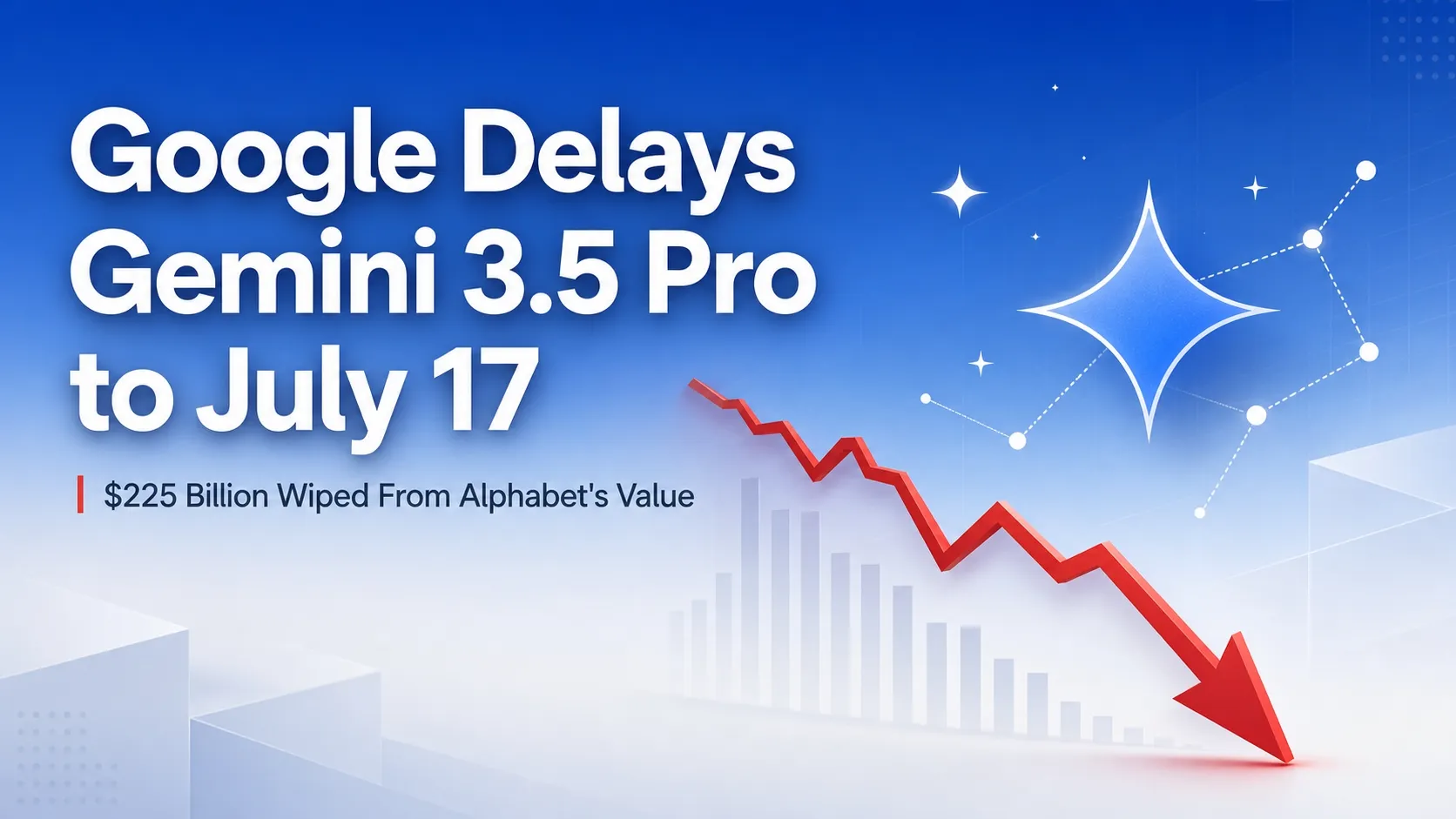
Google has delayed its flagship Gemini 3.5 Pro until July 17, 2026 after deciding to rebuild the model on a new foundation instead of shipping it in June as planned. The delay came during the same brutal 10-day period in which star researchers defected to rivals, wiping out about $225 billion from Alphabet’s market value. The viral version of this story is dramatic and mostly true, but the details matter.
Here is the exact image:
-
Postponed to July 17th. From a June window, Sundar Pichai teased at Google I/O in May.
-
Base model scrapped. DeepMind abandoned the previous 2.5 Pro base and ran a new pre-training cycle on a Gemini 3 base.
-
225 billion dollars gone, but in a sentiment-driven trading session, there was no collapse in the deal.
Why “built from scratch” is fair, with a caveat
The claim for reconstruction remains. According to several media outlets, DeepMind has scrapped the 2.5 Pro base architecture after hitting performance limits in areas such as multi-level mathematical reasoning and SVG scene generation, and launched an extended pre-training run on a native Gemini 3 base. The goal is to close the gap to OpenAI and Anthropic’s GPT-5.6 models, rather than delivering an incremental update.
The newly created model reportedly offers a 2 million token context window, a new “deep think” reasoning layer for complex problems, and more autonomous, agent-based workflow capabilities. It’s worth emphasizing: these are reported and planned specifications, not verified benchmarks. Therefore, treat the feature list as intention and not as evidence.
The $225 billion needs context
The market number is real but can be easily misunderstood. According to a Wall Street Journal report, Alphabet shares fell about 5% in a single session on June 22, their worst day in over a year, losing around $225 billion in value. It is crucial that the article relates entirely to the model conversion.
The reporting tells a larger story: The bigger trigger was a brain drain. In a week, Gemini co-leader and Transformer co-author Noam Shazeer traveled to OpenAI, and Nobel laureate John Jumper (of AlphaFold) traveled to Anthropic along with two other senior DeepMind researchers.
So the decline reflects both the lag and the departures, understood by investors as a single narrative: Google missing its schedule while losing the people who built its lead. The analysts also kept perspective. A $225 billion swing depends on sentiment, not fundamentals. Google Search, YouTube and Cloud continued to make gains despite the decline, and Morgan Stanley, JP Morgan and Goldman Sachs remained bullish, citing Google’s computing power, distribution and existing models.
The takeaway food
This is a real setback, not a death spiral. A few weeks delay in a border model is routine; What made this game so painful, in addition to historic departures, was the timing. Gemini 3.5 Pro will now have to be made available to a more skeptical audience on July 17th, while the cheaper Gemini 3.5 Flash can already handle large-volume work.
If July benchmarks hold up and search, cloud and advertising revenues hold, much of that $225 billion could quickly unravel. The launch just became one of the most important days on Google’s calendar.
Quick links:



