



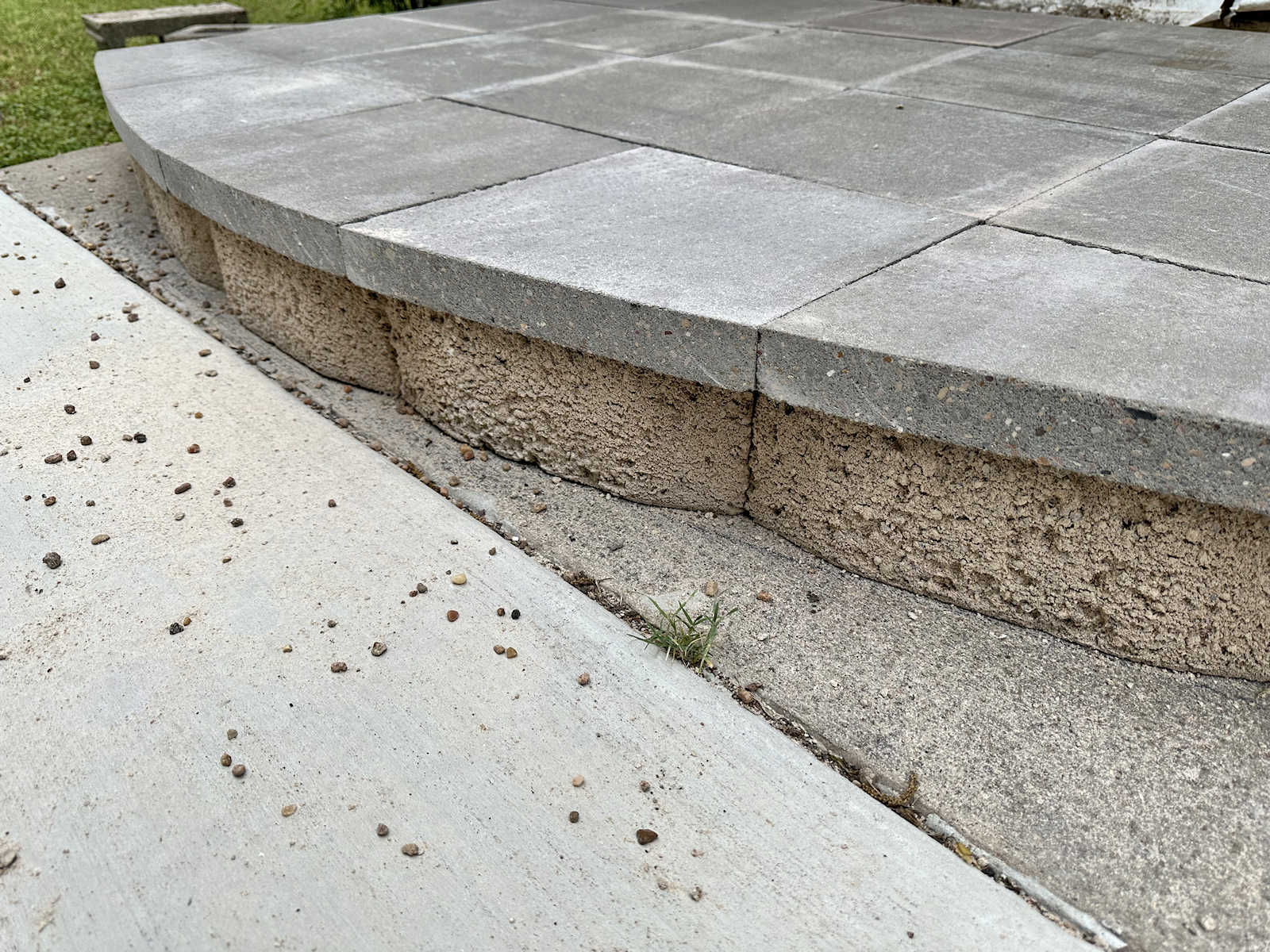
Last Friday I was sure I would finish the side stairs to the studio over the weekend. That didn’t quite work for two reasons. First, I decided to take a day off to relax and not think about house projects, so I lost a whole day of work. I preferred the air conditioning and relaxing to working in the hot sun. (These side steps are in direct sunlight most of the day.)
But the second reason is the main reason. I wanted to do more research and reading before moving forward with my plan, just to make sure I was building steps that would stand the test of time. And I’m so glad I took the time to do this because based on what I read, I ended up making a pretty significant change to the design of the stages.
My original plan was to cut the retaining wall blocks in half for the interior supports and use those only to support the four corners of each concrete paver. This was the last picture I showed of this plan, but I took the photo before I got around to cutting the retaining wall blocks in half.
So as you can see, if I had cut these load-bearing retaining wall blocks in half to use them as supports at the corners where the pavers meet, the center of each paver would have been left exposed.
But before I started cutting these blocks in half to proceed with my plan, I decided to do a little more research to see if this was the best way to accomplish this. So I sat down at my computer and started Googling. First, I wanted to know how much weight 12″ x 12″ x 1.5″ concrete pavers can support. This was Google’s AI response: “A standard concrete paver measuring 12” x 12” x 1.5” will typically hold between 3,000 and 8,000 pounds of weight distributedprovided it stands entirely on a level, properly compacted surface.” It’s obviously the last part that caught my attention – fully supported by a flat, properly compacted base. Obviously this is how pavers are generally used. They are deployed flat on the ground over layers of leveled and compacted gravel and sand. And I know they are very sturdy when used this way because we have concrete pavers all over our property that are in perfect condition and look like they have been there for decades.
Next I asked how much weight they can hold when suspended and supported only by the four corners. Here is the answer I got: “If a standard 12” x 12” x 1.5” unreinforced concrete paver is suspended and supported at the four corners only, it will fail under a central point load of only 150 to 350 pounds.” This is obviously a problem, and it meant that my original draft had to be changed. Thank goodness I hadn’t cut those retaining wall blocks in half yet, and neither the internal supports nor the concrete pavers were glued in place yet.
So I went back to the drawing board. Finally, to give the pavers the support they needed, I filled the entire void within the boundary blocks with as many blocks as I could fit, with only small spaces between them. I still had to cut the back lip of each one so they could lay flat on the concrete slab, and after arranging them, I glued them in place with the same Loctite PL 500 polyurethane adhesive I used for the boundary blocks. It really didn’t increase the price much since these blocks only cost $2.37 each.
After giving the glue some time to cure, I filled any cracks with pea gravel. I had planned to use paving gravel, but this gravel is slightly larger than pea gravel and I thought it wouldn’t fit in the smaller cracks. Pea gravel was the perfect size to get into every single crack. I packed it up as best I could using various tools that fit into the small cracks and then swept away the excess to make sure there was no gravel on the tops of the blocks.
I didn’t fill the voids in the edge blocks. I’m not sure I need to, but I might still go back and do that.
Another thing I did differently this time is I used my wet tile saw to cut the curve into the front pavers. That worked so much better! With the tile saw I was able to get a clean cut on the first cut, which gave them a much better look. It wasn’t as quick and easy as cutting 1/4-inch thick tiles, but with the right blade it got the job done.
There are still some blade marks on it so I still want to sand those down once I get the sanding/polishing wheel for my hand sander. But even as they are now, I think they look really nice.
Here is a comparison of one of the pavers cut in two different ways. The top one is one that I cut in half with my hand sander and then knocked off the excess with a hammer. You can see how much sanding and polishing would have been needed to make it smooth. Below are the ones I cut with my wet tile saw. The difference is night and day. Cutting with the tile saw is such an improvement that these saw blade marks don’t bother me at all. But I’ll probably still try to clean them up a bit.
I still haven’t glued these pavers down. Before I do that, I need to do a bit of readjustment. And after they’re glued down, I want the sanding/polishing wheel to go over the tops of all of them just enough to remove the dirt and dark color from them so that the color is even. And then I’d like to seal them before moving on to the next step so they’re less likely to get dirty and dark again.
I’m so glad I took the time to do more research before moving forward. At this point I am completely confident in my plan. This step is solid. It took a while to get the plan right, try out the plan, etc. But now that I have a solid plan and know the exact steps I need to take to make this happen, I think the other two steps (and the other steps on the bedroom door) will go much faster. Experimenting, researching a plan, designing a plan, and then figuring out how to execute that plan is the slowest part of a project. But now that I’ve solved all the problems, the rest should go much smoother and faster.



