



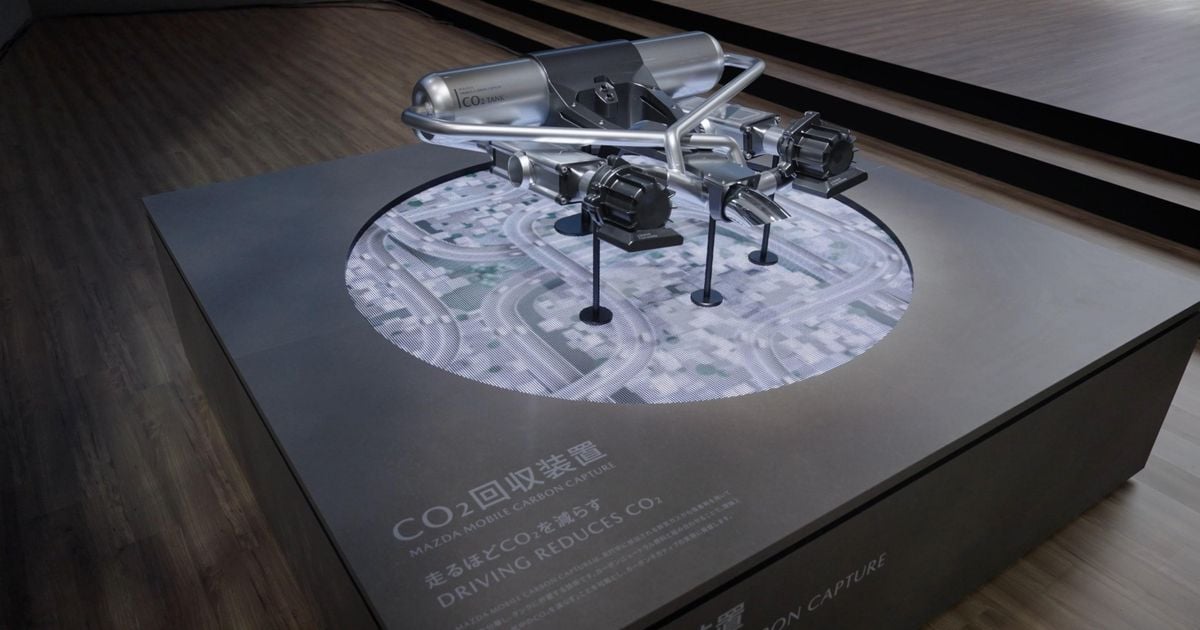
Mazda is experimenting with a carbon capture system that can capture some exhaust emissions directly from a running engine – a technology the company says could make combustion cars significantly cleaner while electric vehicles remain dependent on fossil fuel power grids.
Speaking to Australian journalists at this week’s Tokyo Motor Show, Mazda CFO Jeff Guyton revealed that the company has developed a prototype exhaust-mounted capture device that can store about 20 percent of a vehicle’s carbon dioxide emissions in a special tank.
“The exhaust from an engine is really CO2 rich. It’s a targeted environment from which to absorb CO2,” Guyton said.
“In the vehicle environment … we can then capture that carbon and use it. Maybe it’s an exchange. Maybe when you fill up the car you change a filter or a substrate, and that thing – maybe that CO2 – is something you can sell.”
With Daily Sparkz you can save thousands on a new car. Click Here to get a great deal.
Mazda plans to publicly test the technology in an endurance race car later this year, collecting data under full-load conditions before deciding whether it can be scaled up for road use.
“We are continuing to develop the technology, but what we have prototyped so far is very promising and we will demonstrate that in an endurance race later this year… we will get data from this race car in racing conditions,” he said.
According to Mr Guyton, the system captures about a fifth of the CO2 emitted by passing exhaust gases through a drying process and binding the carbon to a crystalline zeolite substrate.
“Hot exhaust gases flow through the pipe… the system sucks out some of what comes out of the tailpipe. It dries it so that what’s left is essentially CO2, and then in our prototype there’s a kind of crystalline structure made of zeolite… about 20 percent of the CO2 that would otherwise come out stays in the device.”
While Mazda hasn’t announced when or if the technology will enter production, the concept points to another path to reducing vehicle emissions – one that could extend the life of internal combustion engines even as electric vehicles (EVs) gain political support.
The captured gas is stored in a small onboard tank, which may need to be replaced or emptied. According to Mazda, the spent CO2 could potentially be reused as raw material for recycled plastics or industrial processes.
Mr Guyton suggested that the company’s early work with carbon-based composites, unveiled in Tokyo in the Vision X coupe concept, could be directly linked to this research.
“These black parts are made from recycled carbon, not from our carbon capture device, but maybe one day. This black molding is a very unique plastic made from recycled carbon,” he said.
It’s typical Mazda-style innovation: small-scale, pragmatic and focused on incremental real-world benefits rather than blanket promises. Mr. Guyton admitted that the company doesn’t have the resources to pursue every new technology at once.
“It’s not big. I mean, we’re a small company, that’s true. So our attitude is that Mazda can do everything, we just can’t do everything at once,” he said.
For Australia, where Mazda remains a top three brand by sales but offers limited electrification, this kind of development underlines the company’s cautious approach to zero-emission driving. As competitors roll out complete battery lines to meet the New Vehicle Efficiency Standard (NVES), Mazda continues to invest in technologies aimed at making gasoline engines cleaner rather than replacing them entirely.
The carbon capture prototype is part of Mazda’s broader “multi-solution strategy,” which also includes plug-in hybrids, rotary range extenders and biofuel experiments. Mr Guyton argues that such innovations, if made affordable and scalable, could help existing vehicles (not just new electric vehicles) reduce their net emissions.
It’s an idea that may not fit the political narrative, but could prove more viable in markets like Australia, where energy production is far from carbon neutral and electric vehicle infrastructure remains patchy.
Mazda’s next challenge will be to prove that the system can work reliably in mass-market cars without adding excessive cost or weight.
For now, it remains an ambitious laboratory experiment that expresses the company’s determination to make combustion technology part of a cleaner future and not fall victim to regulation.
MORE: Plug-in hybrid city car concepts unveiled by Mazda
MORE: Mazda says electric vehicles “don’t really save the planet” and urges rethinking well-to-wheel emissions
MORE: Mazda is keeping the rotary engine alive: the double-rotor hybrid concept signals a future resurgence of the sport



