



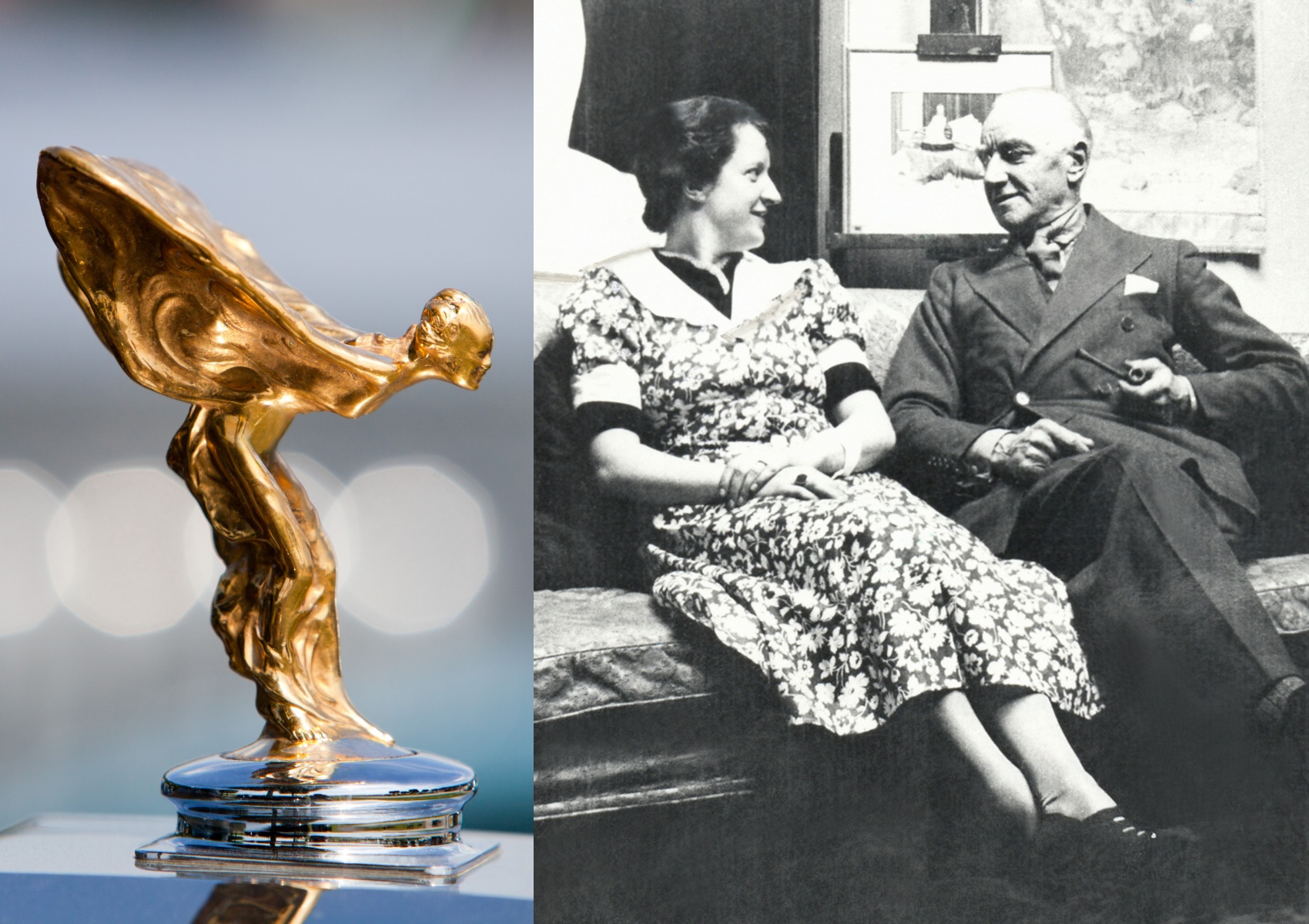
The Spirit of Ecstasy is one of the most recognizable mascots in the automotive world, but its origins go back to a single artist whose influence continues to shape Rolls-Royce today. As the British brand celebrates the 150th birthday of Charles Robinson Sykes, we turn our attention to the artist who quietly gave Rolls-Royce his creative soul.
Sykes was born in 1875 in Brotton, a mining village in North Yorkshire, and grew up far from the aristocratic circumstances that his works would later portray. Encouraged by family members with artistic interests, he trained at Rutherford Art College in Newcastle before winning a scholarship to the Royal College of Art in London. There he studied drawing, painting and sculpture, creating a foundation that allowed him to work in multiple disciplines with equal confidence.
By the beginning of the 20th century, Sykes had established himself as a respected advertising artist and sculptor. Under the pseudonym Rilette, he created magazine covers, advertisements and illustrations that are now held in the collection of the Victoria and Albert Museum. His sculptural work achieved similar recognition. One of his bronzes, “A Bacchante,” was exhibited at both the Royal Academy in London and the Paris Salon, highlighting his place in the world of fine art.
Sykes did not work in isolation, as he eventually crossed paths with John Montagu, the editor of The illustrated car, and with Claude Johnson, the first managing director of Rolls-Royce. Another important figure was Eleanor Velasco Thornton, Montagu’s office manager and frequent role model for Sykes, whose presence is part of the broader human context surrounding the creation of the Spirit of Ecstasy.
Before there was an official Rolls-Royce mascot, Sykes sculpted a small figure for Montagu’s Rolls-Royce Silver Ghost. Known as “The Whisper,” it depicts a woman in a robe holding a finger to her lips. Eleanor modeled for the piece and Montagu featured it on his cars for many years.
At the time, hood ornaments were common on luxury cars. Many were expressive, some elaborate and not always in keeping with the image Rolls-Royce wanted to project. In 1910, Johnson proposed the idea of an official mascot that would reflect the brand’s values. He convinced a reluctant Henry Royce that Rolls-Royce needed an official emblem, one that would highlight the car rather than distract from it. He commissioned Sykes and suggested classical inspirations, including the Nike of Samothrace.
“Best known as the sculptor who created the Spirit of Ecstasy, Sykes was a versatile and prolific artist whose work remains highly regarded 150 years after his birth. He was the first of the brand’s founding figures to infuse Rolls-Royce with artistry and creativity, a legacy that continues today in our increasingly ambitious and elaborate bespoke and coachbuilt work.” – Andrew Ball, Head of Corporate Relations, Rolls-Royce Motor Cars.
Ultimately, Sykes created a more reserved figure, suggesting movement and grace rather than drama. This character eventually became the Spirit of Ecstasy. Although opinions on mascots varied within the company, Johnson supported the project and the design was officially adopted in 1911. In 1920, the Spirit of Ecstasy gained international recognition when it won a Paris automobile mascot competition.
Sykes personally cast and finished the figure over many years to ensure subtle variation in each example. 150 years after his birth, his contribution is not just a symbol, but a lasting reminder that craftsmanship and artistic expression have always been central to Rolls-Royce’s identity.
Images: Rolls-Royce Motor Cars, Khris Bharath



