



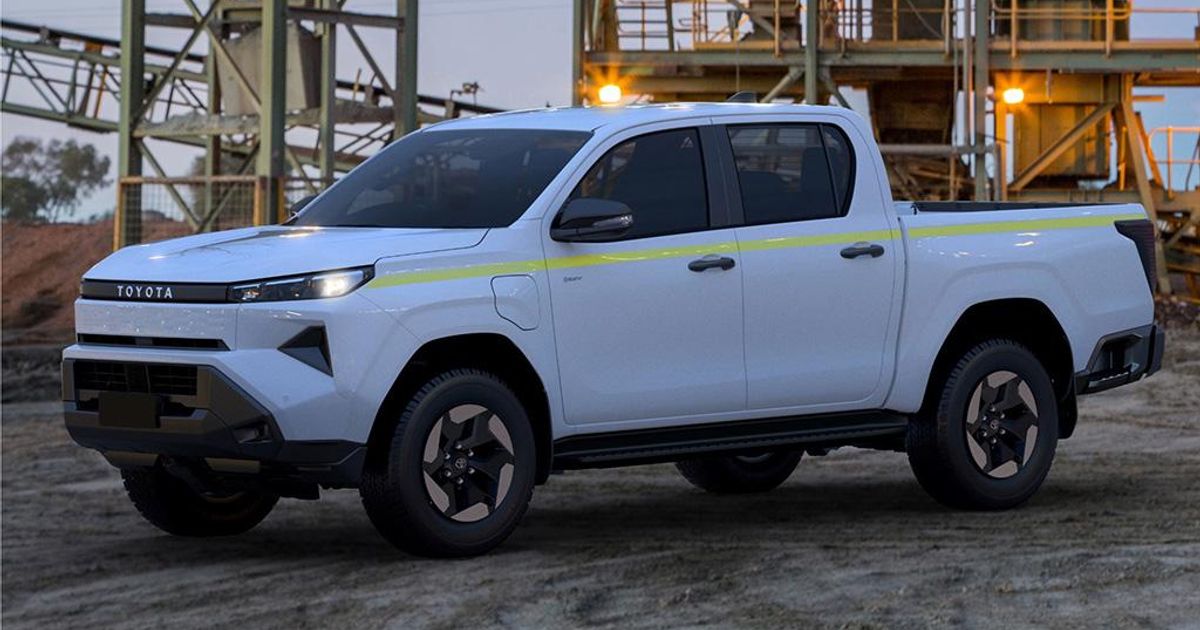
Toyota says the addition of an electric version of its new generation HiLux – and the announcement of a hydrogen fuel cell-powered HiLux for 2028 – is not just a play to comply with increasingly stringent emissions regulations.
Order books for the new generation HiLux will open next month and from the first quarter of 2026 the range will include an electric version.
Toyota Australia is also launching a HiLux fuel cell electric vehicle (FCEV) in 2028.
The new HiLux models come onto the market as part of Australia’s New Vehicle Efficiency Standard (NVES), which came into force in 2025 and set carbon dioxide emission limits for each brand.
With Daily Sparkz you can save thousands on a new car. Click Here to get a great deal.
Brands that go above the average for all vehicles they sell face fines – those below can secure “credits” that they can resell to other car manufacturers.
However, Toyota Australia has argued the new HiLux variants will not be as helpful in achieving its goals as its growing range of hybrids and plug-in hybrids.
“The (HiLux BEV) volume is almost incidental in the grand plan of over 200,000 cars,” Toyota Australia vice president of sales and marketing Sean Hanley said at a media briefing.
Toyota, the best-selling car brand in Australia since 2003, sold a record 241,296 vehicles here in 2024 and is on track to sell a similar number this year.
“Every BEV is helpful because you build credit, right? So every BEV you sell is going to be helpful – but plug-in (hybrid) and hybrid are incredible helpful,” Mr. Hanley said.
“NVES will undergo further review at the end of 2026. We would like to ask the government to examine NVES very carefully to develop (a) ZLEV (Zero and Low Emission Vehicle) approach.
“That means zero to low emission vehicles – that would be plug-in hybrids, BEVs, fuel cell electric vehicles… We would suggest that hybrids should still play an integral role in any NVES development, but we will have to wait and see whether that comes to fruition.”
Mr Hanley said the carmaker was not calling for a relaxation of emissions limits, but said hybrids and plug-in hybrids should count towards NVES credits on an ongoing basis, even if they do not fall within the NVES limits.
The new LandCruiser Hybrid, due to hit the market here in March 2026, is one such vehicle. Mr Hanley confirmed he will be penalized under NVES for failing to comply with the 2026 limits.
“I suggest that the ZLEV approach for a period of time – perhaps not forever, for a period of time – would be a more sensible policy approach and would ensure that we move towards decarbonisation,” Mr Hanley said.
“Because now look at this… our statistics say that just under fifty percent of all the cars that we’re going to sell – we’re talking about hundreds of thousands of cars that we’re going to sell this year – almost fifty percent are going to be hybrid vehicles.”
“What does this tell you about the current market? I suggest that hybrid models should continue to count towards credits for some time.”
“I understand that you have to reduce carbon emissions… but if you want to move to decarbonization, you have to take consumers with you, because if you turn them off, you know what happens? They’re stuck with what they have. Will that decarbonize us faster?”
Toyota has been criticized globally for its slow adoption of BEVs and is sticking to its “multi-pathway” approach with different powertrains – including hybrid, diesel, PHEV and BEVs – for different markets.
In 2025, the company introduced its first BEV, the bZ4X mid-size SUV, in Australian showrooms and will follow in 2026 with the bZ4X Touring and the HiLux BEV.
The C-HR BEV has been confirmed for 2027, with the HiLux FCEV set to go on sale in Australia in 2028.
MORE: Explore the Toyota HiLux showroom



