



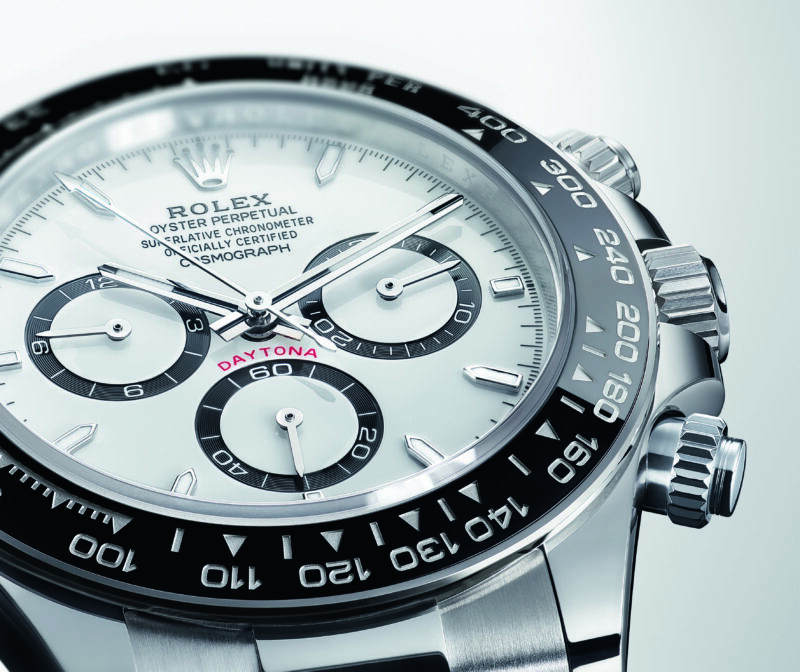
The chronograph has long since become a cornerstone of automotive and watchmaking history and was even the first watch to land on the surface of the moon.
Considered one of the most versatile timepieces of all time, the chronograph can function as both a stopwatch and a traditional watch. It has become a staple for collectors and enthusiasts who appreciate its everyday utility and historical significance.
Historically, the chronograph has been associated with influential figures such as Paul Newman and Steve McQueen and further cemented its position in the luxury watch timeline with examples such as the Rolex Daytona Cosmograph and TAG Heuer Carrera. For automotive enthusiasts, the chronograph represents the bridge between the realms of racing and haute horlogerie. Whether for measuring lap times or fine-tuning a racing car’s capabilities on the track, the chronograph offers multiple levels of accuracy that are essential for both drivers and teams.
When you understand how a chronograph works, you can see why it is such a valuable tool for racing. The functionality sets it apart from all other wristwatch variants, which is why its technology has been adopted by Swiss watch icons such as Rolex, Audemars Piguet, TAG Heuer and many others. While it has the basic functions of a standard wristwatch, additional complications allow for remarkably accurate measurement of elapsed time. This is achieved through additional sub-dials and pushers that control the stopwatch function separately from the primary time display. For pioneers and modern drivers, this is important for tracking lap times and analyzing other performance metrics.
The origin of the chronograph dates back to 1816, when Louis Moinet, a French watchmaker, created the first modern chronograph. His invention was able to measure time to within one-sixtieth of a second and is still considered a significant advance in precision, laying the foundation for future developments in timekeeping technology. Without Louis Moinet and his ingenious creation, there would be no coveted models in the watch world like the Zenith Chronomaster Original and the Omega Speedmaster.
In racing, the chronograph’s ability to provide detailed time information is invaluable. Accurate lap times and performance measurements help teams and drivers make strategic adjustments and improvements. Imagine standing trackside at the 24 Hours of Le Mans, carefully monitoring lap times from your wrist to ensure a victory at the checkered flag. Despite technological advances, the chronograph is still a relevant tool in motorsports today due to its straightforward design and accuracy.
The Chronograph offers a compelling entry point for anyone interested in luxury watch collecting, with a wide range of price points and styles sure to suit the needs of any watch lover. Its historical significance coupled with its practical functions make it a remarkable piece for both experienced collectors and newcomers. The mix of functionality and tradition ensures the chronograph its place as a respected and enduring part of the world of fine watches.



