



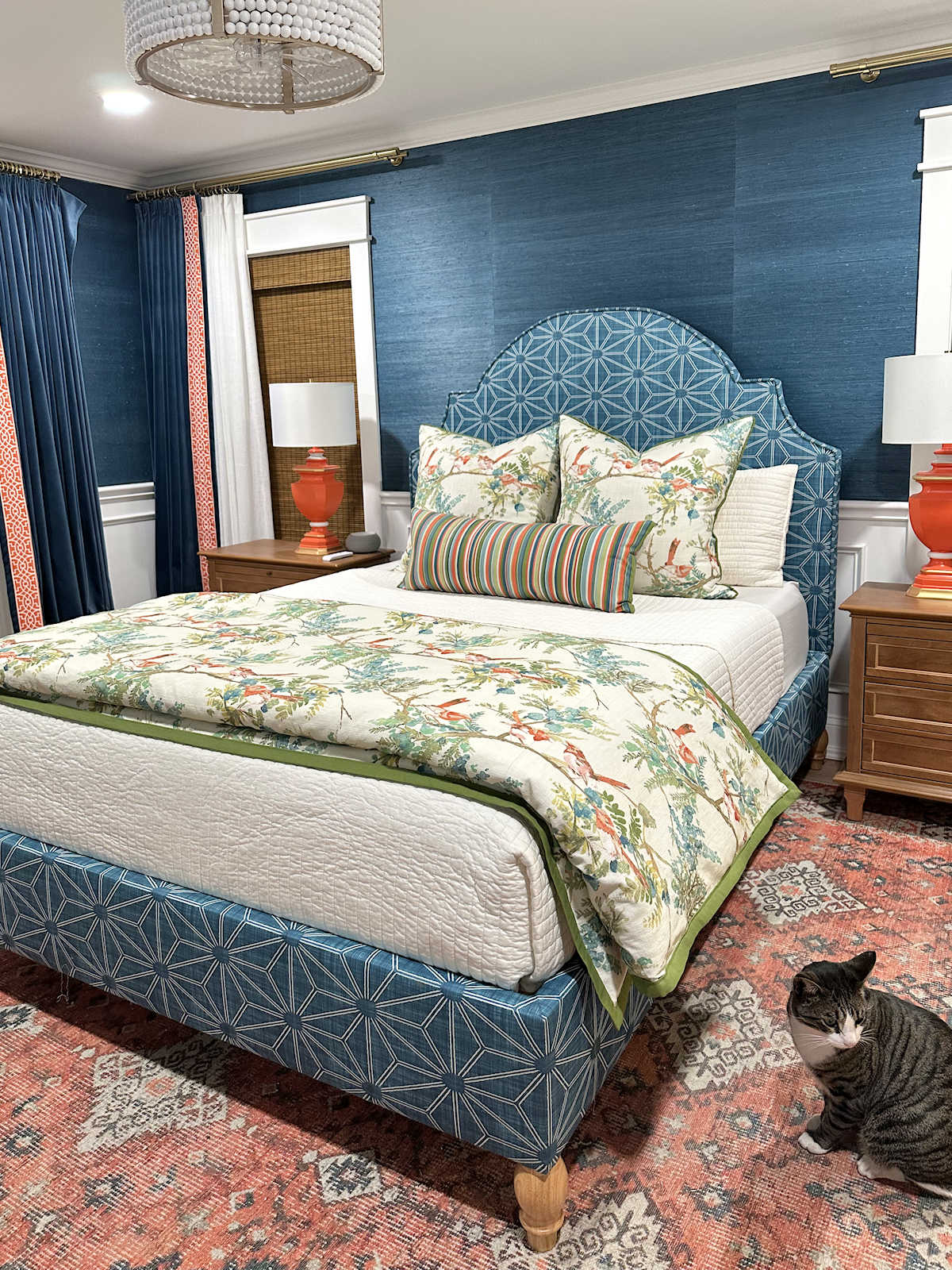
Last night I crossed a big bedroom project off my to-do list. I finished sewing the duvet cover for the bed. Now all of the bedding is officially finished and my beautiful bird fabric is much more present in the room.
Sewing a duvet cover is actually pretty easy. It’s basically a giant pillowcase. So if you can sew a pillowcase, you can also sew a duvet cover. Of course, what makes them a little more challenging than a simple pillowcase is that they’re huge, so you have to deal with a whole lot of fabric. And another challenge is that decorative fabrics often come in widths of 55 to 60 inches. So if you are sewing a duvet cover for a queen or king size bed, the fabric pieces must first be assembled before you can even begin sewing the duvet cover together. Let me show you how to sew a duvet cover with contrast trim.
I started with my outer fabric – the bird fabric. For my queen size duvet cover, I cut two panels of fabric to 100 inches. I cut them much longer than I needed for the finished length, but I wanted to allow for a lot more because I had to adjust the patterns when sewing them together and you always lose some fabric when adjusting the patterns. One piece remained intact. For the second piece I had to cut it in half lengthwise.
And then I laid the whole piece face up on my work table…
And then I pinned one of the half pieces to each side, making sure it matched the patterns. (Tiger wasn’t interested in making me work. He wanted attention, so he made it a little harder for me. )
I won’t go into detail about how to match patterns as there are many videos on YouTube showing the process of pattern matching. After pinning them together, I sewed these three pieces together using the required stitch width to match the patterns. Again, I refer you to YouTube to learn how to combine patterns in patterned fabrics.
I repeated the same process with the fabric for the back of the duvet cover. This one was easier because it was a solid fabric and there was no need to match patterns. After sewing both the top and bottom of the duvet cover, I ironed the seams open and flat with my steam iron.
On the back piece I measured 10 inches from the bottom and drew a line. And then I cut along that line. This creates the opening for inserting the duvet into the finished duvet cover.
And then after cutting along that line, I put a double 3/4 inch fold in each piece where they met and sewed that double fold in place.
Here you can see where I attached the double fold to the narrow piece, but I had turned it inside out so I could measure, pin, and iron it more easily when the edge was closer to me.
I should have done this next step before cutting off the top 10 inches, but I measured and marked my finished width. For a queen size duvet cover I didn’t need the full two widths of fabric. My comforter was 88 inches wide, so I cut the bottom of the comforter to 90 inches wide to leave room for my contrast trim on the edge, which would be 1 inch wide.
I repeated this on the other side and then trimmed off the excess fabric.
After sewing the hem in both pieces where the opening on the back piece would be, I overlapped them about 1.5 inches and pinned them together. I then cut the finished length of the back piece. My comforter was 88 inches square, so I also shortened the length to 90 inches. And then I laid the piece face down on my work surface.
And then I spread the top part of my duvet cover over the bottom part, making sure it was straight, and pinned the two pieces (bottom and top) together along the seams and around all four edges.
And then I used the bottom piece that was already cut to cut the top piece to size. To do this I had to turn everything inside out, so I should have laid everything out from the start with the bird fabric on the bottom and the backing fabric on top. That would have saved me a lot of work.
I never got everything to lay perfectly flat, but there is a little wiggle room with duvet covers so I wasn’t worried about it.
Before sewing these pieces together, I added ribbons to all four corners and in the middle of the sides, top and bottom. I used cotton ribbon trim for this and cut about 10 inch strips for each tie.
Then I folded each piece in half and pinned it between the layers of fabric.
I tucked the tie between the two layers of fabric and then pinned the fabric back together.
After attaching the straps, I sewed the two fabrics together on all four edges using a 1/2-inch seam.
Next I cut the fabric for my contrast edge trim. I needed a little over 360 inches to completely wrap my duvet cover, so I cut as many strips as I needed for that length. I cut these strips 4″ wide.
After cutting all the strips, I pinned them together as shown below.
And then I sewed them together diagonally.
This is a terrible picture. I didn’t realize my camera wasn’t focusing. But once you open that seam, this seam looks like this.
The reason they are sewn together diagonally instead of a straight 90 degree seam is because it reduces bulk. With a diagonal seam, the majority of that seam is spread over a larger area, rather than confining all the layers of fabric to a much narrower area, giving the finished piece a much cleaner look.
After sewing all the strips together, ironing out the seams, and cutting off the excess fabric, I was able to iron out the wrinkles. I laid the fabric face down on my work surface…
And then I folded the fabric in half lengthwise and used my steam iron to get a really clear crease.
And then I opened the fabric, folded the bottom edge up to the center fold and pressed it in place.
And then I repeated this process at the top.
And then I folded it again along the center fold and pressed it again to get my finished 1 inch wide final cut.
To attach it to the duvet cover, I simply opened that edge…
And then I wrapped it around the edge of the duvet cover…
And then I pinned it. I continued this process around the entire duvet cover until I got back to where I started. Once I reached the starting point, I trimmed the trim about two inches past the starting point, folded it down, and pinned it to the top of the starting point trim, overlapping it by about an inch.
Once it was pinned all the way around, I sewed the facing in place. I sewed about 1/8 inch from the inside edge of the facing.
The final step, which I haven’t done yet, is adding buttonholes and buttons to the overlapping area on the back of the duvet cover. The reason I haven’t done this yet is that now that we no longer have fabric stores in our town (RIP Joann Fabrics), there is no convenient place where I can just buy some buttons. So I had to order the buttons online, but they haven’t arrived yet. I don’t want to sew any buttonholes here until I actually have the buttons in my hand.
But once I have these buttons in hand, I can finish this flap so that the two pieces attach together and hold the comforter in the duvet cover.
But until then, I just put the duvet in the duvet cover and simply tucked the flap shut. And here is the (almost) finished duvet cover.
I absolutely love the result and am so glad that the bird fabric now has a much bigger presence in the room.
And now the bed linen is completely finished.
I just love this fabric so much and am so glad I could use more of it in the room.



