



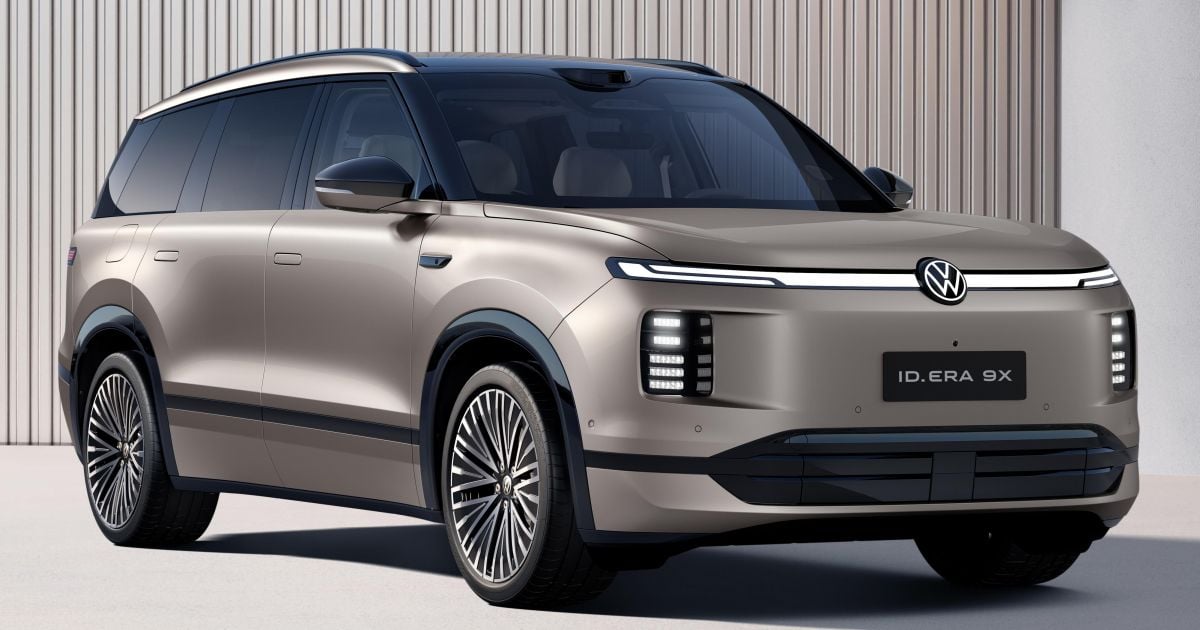
The Volkswagen ID.Era 9X The six-seat SUV is the automaker’s first range-extended electric vehicle (EREV) and is scheduled to launch in China later in 2026.
The ID.Era 9X was developed specifically for China together with Volkswagen’s Chinese joint venture partner SAIC – which includes brands such as LDV and MG – and was first shown in concept form at the 2025 Shanghai Motor Show.
Now details about the production SUV – including exterior dimensions and powertrain specifications – have been released.
At 5207mm long, it is one of the largest vehicles the brand has ever produced, surpassing the Touareg sold here (4902mm) and even the Atlas (5097mm) and Talagon (5168mm) three-row SUVs sold abroad.
The German automaker has yet to confirm the ID.Era 9X for export markets. Should it continue to be available exclusively in China, it will be part of a large contingent of vehicles being developed for that market, from the small crossover SUV Tharu XR to the large people mover Viloran.
With Daily Sparkz you can save thousands on a new car. Click Here to get a great deal.
Local Volkswagen showrooms currently only offer a single hybrid model, the five-seat Touareg plug-in hybrid (PHEV), although PHEV versions of the Tiguan and Tayron SUVs have been announced for Australia in 2026. There is a wider range of PHEVs available in Europe, with conventional hybrid powertrains also planned, starting with the upcoming second-generation T-Roc.
Three different drive configurations of the ID.Era 9X have now been announced for China.
All versions use a 1.5-liter turbo gasoline engine from the Volkswagen EA211 modular engine family, which, as a range extender, functions exclusively as a generator to charge the battery.
The entry-level version uses a 51.1 kWh lithium iron phosphate (LFP) battery, providing an electric range of 267 km on the CLTC cycle.
A larger 65.2 kWh nickel manganese cobalt (NMC) battery increases the electric range to 340 km, paired with a 220 kW electric motor driving the rear wheels.
Volkswagen claims fuel consumption of 5.9 l/100 km for both rear-wheel drive versions.
An all-wheel drive version uses the larger 65.2kWh battery and adds a front-axle motor, delivering a total power output of 380kW, a claimed electric range of 321km and fuel consumption of 6.3L/100km.
There are no official figures for the total range as the six-seater SUV weighs up to 2700 kg.
Bloomberg has reported that the Volkswagen brand is considering offering EREVs in the US and Europe, given the increasing popularity of hybrid vehicles in these markets over the past 12 months.
Previously, EREVs were confirmed for the US market under the new off-roader brand Scout, although not for the Volkswagen Group brand of the same name.
While Volkswagen, like many other manufacturers, previously bet heavily on electric vehicles (EVs), the company has since revised its plans to reflect the slower adoption of electric vehicles and growing demand for hybrid powertrains, although its EVs are selling well in Europe.
The European Commission has also announced plans to relax its previously proposed 2035 rules that effectively ban new internal combustion engine vehicles, which will impact carmakers’ future product strategies.
In the U.S., sales of hybrid vehicles have surged as demand for electric vehicles is hit by import tariffs and the end of consumer tax incentives, which were eliminated in September 2025.
Hybrid sales have also risen sharply in Australia, rising 15.3 percent year-on-year in 2025 after growing by an incredible 76 percent in 2024, largely due to Toyota switching the majority of its passenger car lineup to pure hybrid powertrains from 2024.
MORE: Explore the Volkswagen showroom



