



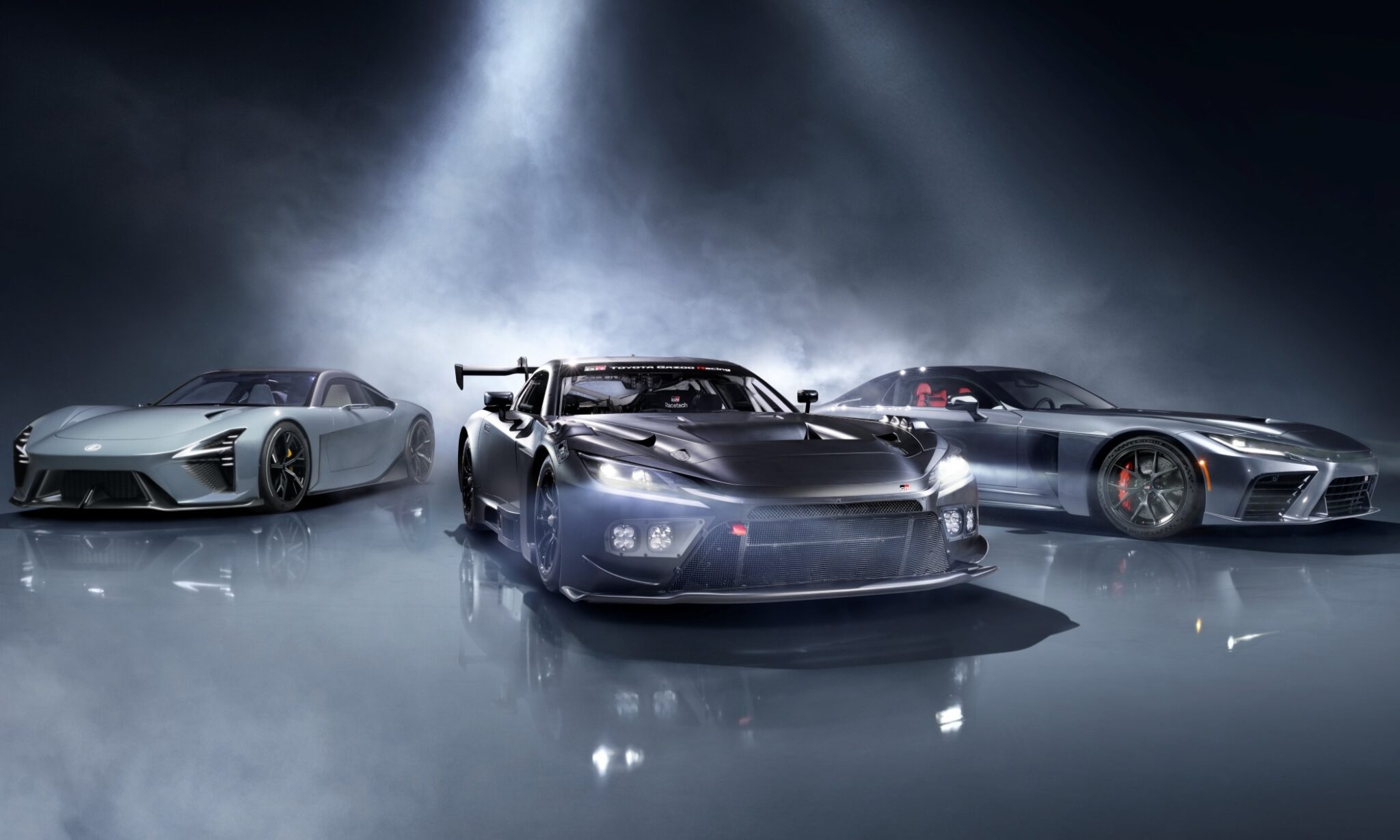
Toyota Gazoo Racing and Lexus have finally given us the moment we’ve all been waiting for. The successor to one of the greatest road cars ever built has a name: GR GT. Over in Toyota Woven City, Japan, the world’s largest automaker has unveiled not one, but three high-performance flagships: the GR GT, the GR GT3 and the Lexus LFA Concept.
But before we get to the GR-GT, first some context. Looking back at the original LFA, except that it was The As a flagship, this car’s highlight was its high-revving 4.8-liter V10, which made 552 horsepower and 354 pound-feet of torque. Capable of reaching 9,000 rpm, the Yamaha-tuned 1LR-GUE won awe through sensation and an atmospheric soundtrack, not pure performance numbers. It proved that Japan could build a halo car that belonged in the same discussion as, say, mid-engined exotics like the Carrera GT. As time passed, a successor was not only inevitable but imminent.
Momentum surrounding a possible LFA successor increased in 2021 when Chairman Akio Toyoda launched his mega line of 30 BEV concepts. Among them was a lowered coupe that was quickly named LFR. In 2022, the GR GT concept appeared with a front engine and rear wheel drive. A year later, a short Fuji Speedway clip surfaced on Twitter (now X), and the tone was unmistakable. No longer a V10, but something deeper like a V8. Since then, prototypes have been spotted at the Nürburgring, on test tracks in California, at Goodwood and even at the Quail as the Lexus Sport Concept.
Then came the teaser at Japan Mobility Week last month, showing the 2000 GT, the LFA and a gap waiting to be filled. Now Toyota is launching something new to carry on that torch, and this time the approach is all about performance and track consistency.
Toyota describes the GR GT as a street-legal version of its GT3 race car based on the same platform, and the spec sheet backs this up. Under the hood sits a 4.0-liter twin-turbo V8 with dry sump lubrication, paired with a single-motor hybrid unit integrated into the rear axle drive. Power is transmitted via a carbon torque tube to a new 8-speed automatic transmission with wet start clutch and mechanical limited slip differential (LSD). Target output is 641 horsepower and 627 pound-feet of torque. Heavy components are mounted low to lower the center of gravity, and weight distribution is 45 percent front and 55 percent rear.
The chassis is Toyota’s first all-aluminum frame, with aluminum castings and extrusions forming the core structure and joined using advanced joining methods normally seen in motorsports. Carbon fiber reinforced plastic (CFRP) and aluminum plates keep the mass under control.
External dimensions confirm the larger footprint. The GR GT is 189.8 inches long, 78.7 inches wide, 47 inches tall, and has a longer wheelbase of 107.3 inches. The original LFA was shorter at about 177 inches, narrower at 74.6 inches, and had a slightly higher roofline. Visually, each of the three cars has its own distinctive character. While the GT GT3 has an aggressive gooseneck fixed wing, the LFA concept appears much more reserved, while the GR GT falls somewhere in between. Inside, visibility and driver connection are a priority. With two screens, one for instrumentation and a larger central display, controls are located near the flat-bottomed steering wheel, physical buttons for added tactility and sporty Recaro seats. Here’s a cabin that puts function front and center.
Development weight was set at 3,858 pounds or less, which would make the GR GT heavier than the original LFA but with far greater aerodynamics, larger footprint and hybrid hardware. You get double wishbone suspension front and rear, 265 front and 325 rear tires on 20-inch wheels, brakes are handled by Brembo carbon ceramics and you get Michelin Pilot Sport Cup 2s designed specifically for this car. These tires are not an off-the-shelf compound.
Simulator testing began early with development at Shimoyama, Fuji Speedway, the aforementioned Nürburgring and even on public roads to ensure a balance between track performance and roadworthiness. One of the biggest development differences from the old LFA is how Toyota built the car. The GR GT follows an aero-first philosophy, reversing the normal design and then the aero workflow. Toyota first fixed the driving position and then shaped the car accordingly. Steering angle, pedal reach and visibility.
The test program followed a simple loop. Ride hard, break something, fix it and make it stronger, repeat the process. Engineering was not a checklist exercise. It was seat time, Morizo pushed for more pace and development riders Tatsuya Kataoka, Hiroaki Ishiura, Naoya Gamo, Daisuke Toyoda as well as internal test riders helped refine feedback at each stage.
In the hybrid system, the motor-generator replenishes torque during acceleration and eliminates the drop in response during shifting, providing constant boost instead of the typical turbo wait. The stability control can be adjusted in several stages and is based on the 24-hour programs of the Nürburgring. This allows drivers to adjust the level of difficulty and slip depending on their ability and conditions. Cooling also played a big role. Ventilation slots built into the body supply the radiator, brakes and hybrid components. Air exits behind the doors to regulate pressure and heat.
This reveal also showcases the GR GT3, a full-fledged FIA GT3 race car designed to win, with its core engine architecture identical to the road-going GR GT. Same 4.0-liter twin-turbo V8, same basic layout, but reduced, hardened and tuned for competitive endurance. Toyota designed the platform to be deployed on networks around the world, with factory support for customer teams, simulator development and a chassis designed for wheel-to-wheel use. In addition, Haas will compete as the TGR Haas F1 Team from 2026, marking the official return of Toyota Gazoo Racing to the top league of motorsport.
And facing that fuel-burning future is the LFA BEV Concept, which Lexus has unveiled as an electric evolution of the original LFA spirit. It shares the same development philosophy as the GR GT and GT3: low center of gravity, high rigidity, aero-first packaging, but applies this to the electrical architecture. Inside there is a wraparound cockpit around the driver as well as a yoke steering wheel. The brand is continuing to expand its motorsport ambitions. Toyota expects development to continue toward a 2027 launch date. Further details will be announced as testing continues. With no Nissan R36 GT-R in sight, the Gazoo Racing GT is Japan’s new halo performance car.
Images: Toyota / Lexus



