



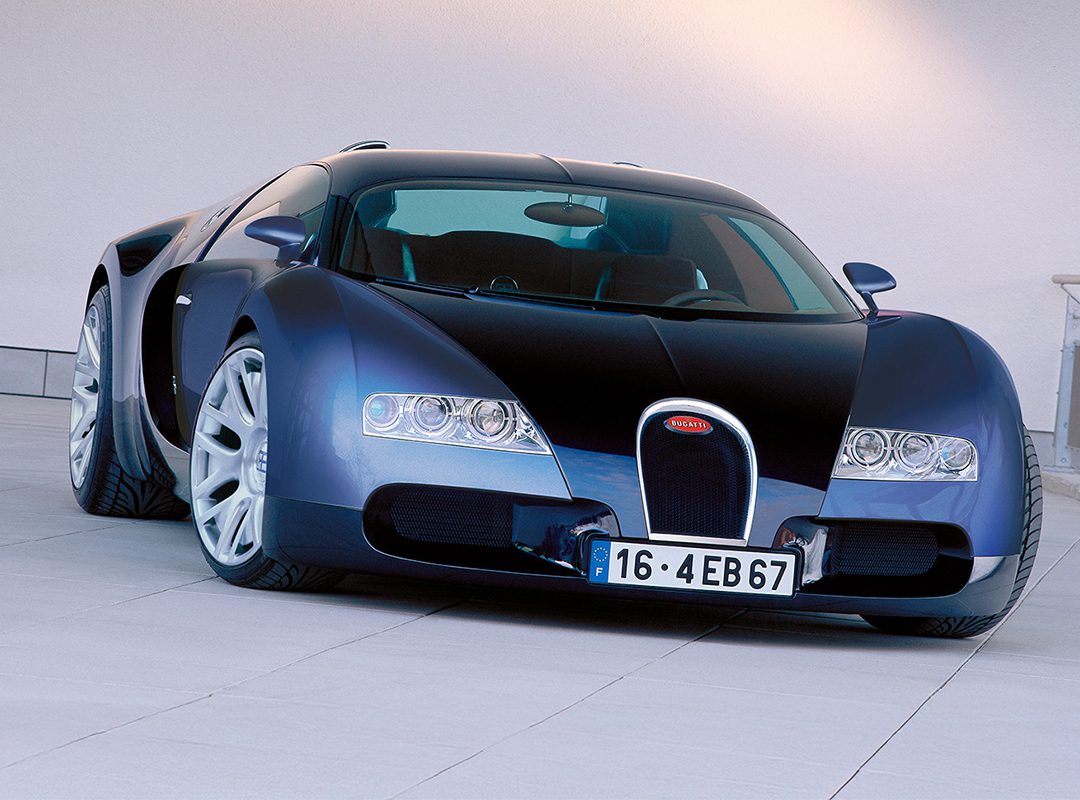
Discover the concepts that led to the Veyron.
A manufacturer’s pursuit of hypercar status was seemingly incompatible given today’s automotive standards and not as easy as one might think. Massive drivetrains paired with hybrid-assisted electric motors are now proving to be a recipe for success in achieving four-digit horsepower values. Still, it’s important to remember where the passion and drive to push performance boundaries comes from. While the true definition of a “hypercar” can be debated with iconic names like the McLaren F1, no other car has shaken up the automotive world like the Bugatti Veyron.
Considering it is a successor to the legendary EB110 and predecessor to modern marvels like the Chiron, Mistral, Bolide and Tourbillon, we often wonder how the Veyron became a timeless icon. The origins of Bugatti and especially the Veyron go back to the ambition of the former CEO of the Volkswagen Group, Ferdinand Karl Piëch. The idea of designing a car that pushes the boundaries of performance, design and luxury came when Piëch dreamed of a revolutionary 18-cylinder engine while traveling on a train in Japan. The very first sketches of his W18 appeared on an envelope and became the driving force behind Bugatti after Volkswagen AG acquired the trademark rights in May 1998.
Bugatti EB 118
When the EB 118 debuted at the 1998 Paris Motor Show, it marked the beginning of Bugatti’s post-war revival under the Volkswagen Group. Designed by Giorgetto Giugiaro, the two-door grand tourer featured a massive 6.3-liter W18 front engine that produced 547 horsepower and distributed power to all four wheels. The car’s long hood, central spine and upright stance were more about presence than performance. Inside, the car leaned heavily on retro luxury, with an Art Deco design DNA and a focus on craftsmanship.
Bugatti EB 218
The EB 218, a sedan based on the same concept, followed at the beginning of 1999. Based on the earlier EB 112, this version was larger and aimed squarely at the ultra-luxury sedan market. The W18 engine and all-wheel drive system remained, but the proportions were expanded to over 17 feet long. With a softer design and four doors, the EB 218 placed more emphasis on comfort and size than performance. It wasn’t about being sporty. It was a luxury platform that showed Bugatti’s interest in building something closer to a modern Type 41 Royale.
Bugatti EB 18/3 Chiron
Things took a different turn with the EB 18/3 Chiron in September 1999. The concept ditched the front-engine layout and placed the W18 behind the seats in a mid-engine configuration. The result was a lower, more performance-oriented car with more traditional supercar proportions. Designed by Fabrizio Giugiaro, it still used the same powertrain as the previous concepts, but focused more on speed and agility. Naming it after Louis Chiron was an attempt to create a connection to Bugatti’s racing history, but the car still felt more like a design study than a finished product.
Bugatti EB 18/4 Veyron
A month later, the EB 18/4 Veyron was unveiled in Tokyo. This time the design came from the Volkswagen Group, with Jozef Kabaň leading the project. The EB 18/4 seemed much closer to a production model, even if it still used the W18. However, the W18’s limitations, particularly in terms of heat and space requirements, soon led to a switch to a newly developed four-turbocharged W16. Still a concept at the time, the EB 18/4 was the final step before series production of the Veyron and suggested the shape and specifications of one of the most influential hypercars of the 21st century.
Source: Bugatti



