



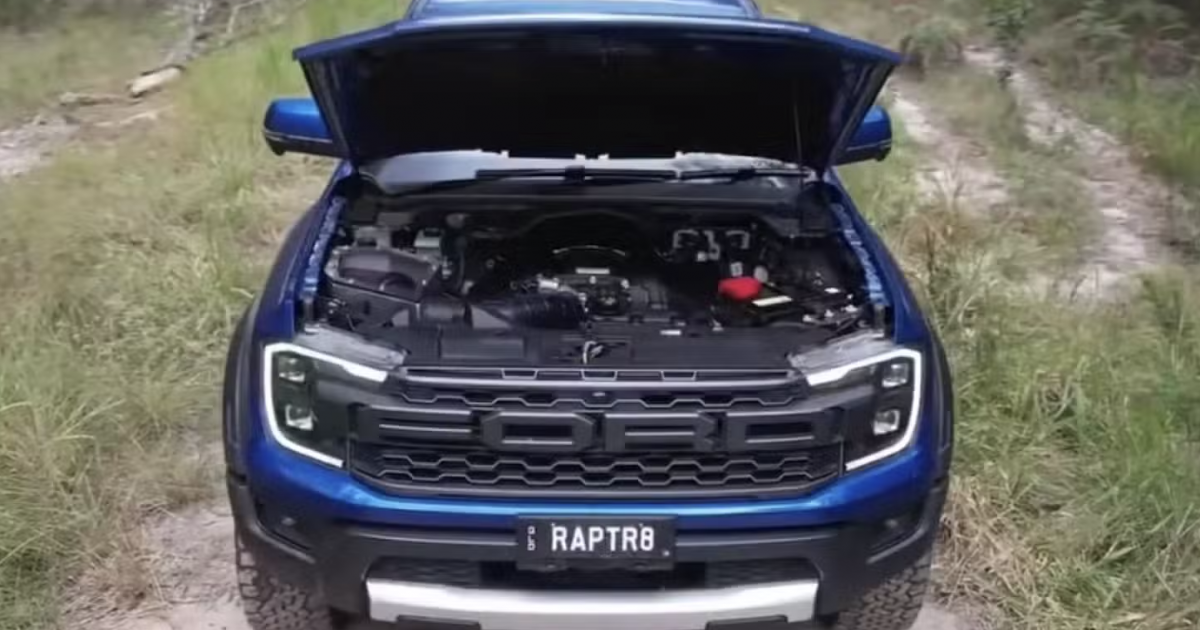
Ford’s revitalized hybrid strategy could soon include a V8 engine as the hero for the next generation Raptor Models.
Ford CEO Jim Farley has opened the door to a V8-powered Raptor that would take advantage of the US automaker’s propensity Dakar Rally 2026 with its specially built Raptor T1+ Racing cars that use a version of the Blue Oval brand’s iconic 5.0-liter Coyote V8 from the Mustang muscle car.
Speaking in the Saudi Arabian desert at the Dakar Rally bivouac – essentially a mobile pit lane that follows the epic 14-day adventure – the outspoken and ever-enthusiastic Ford boss gave the clearest hints yet that a V8 hybrid powertrain could be used in the off-road sector the brand aims to dominate.
With Daily Sparkz you can save thousands on a new car. Click Here to get a great deal.
“Our best-selling F-150 is the EcoBoost Hybrid,” Mr. Farley told the media after mingling with fans on sand dunes and spending time with the factory-backed team, which entered four Raptor T1+ rally-raid machines in what is widely considered the toughest motorsports event in the world.
“In our performance off-road vehicles you can expect increased hybridization, but more on the performance side,” he added.
When asked directly about the prospects of a standard V8 hybrid powertrain, Mr Farley said: “We have accelerated investment in hybrids across our product range – and that will also include off-road power.”
His comments were echoed by Will Ford, general manager of the recently renamed company Ford Racing Department that is now heavily integrated into the future development of Raptor variants.
Mr Ford sees hybrid as key and nominated electrification as a powertrain technology that could extend the life of the V8 in the Blue Oval brand’s lineup.
“It’s pretty clear that hybrid is the high-performance powertrain of the future,” said Mr. Ford, the son of former Ford chief Bill Ford.
“We’re not going to go out on a limb and do something that customers don’t want, but we absolutely need to make sure we continue to push the Raptor forward in every way so that it maintains its position as the most off-road capable vehicle.”
He said a hybrid V8 is “absolutely” on the cards for the Raptor family.
“The nice thing about the hybrid is that it allows us to potentially keep the V8 alive a little longer – hopefully much longer.”
The question is where the V8 hybrid powertrain would fit in the three-part Raptor range – F-150, Bronco and Ranger, the only Raptor model sold in Australia.
The F-150 full-size pickup seems to be the most logical candidate, considering that the flagship Raptor R variant is already powered by a V8.
Reports from overseas suggest a V8 hybrid powertrain is already in Ford’s future model plan, and the gasoline-electric Mustang is currently undergoing advanced prototype testing.
Although Ford hasn’t confirmed details, the move is consistent with a broader shift toward hybrid vehicles as demand for all-electric vehicles declines.
When Ford wrote off $19.5 billion (A$29 billion) in capital investments in mid-December, it told investors it would “reallocate” the capital into “higher-return growth opportunities,” including pickup trucks, vans and hybrid vehicles.
The company also noted that by 2030, about half of its global sales volume will consist of hybrid vehicles (HEVs), extended-range electric vehicles (EREVs) and battery-electric vehicles (EVs), up from about 17 percent today.
With this in mind, Ford appears to be laying the foundation for an off-road electrification strategy that increases performance without diluting character.
Adding an electric motor to a V8 would provide additional torque at low speeds, providing performance and efficiency benefits.
The strategy is not dissimilar to that of Porsche, which recently introduced its first 911 with a hybrid drive. However, the introduction of electric motors to the classic boxer six-cylinder engine in the German automaker’s most famous sports car was more about increasing performance than saving fuel.
Mr Farley said hybrid technology could provide benefits that matter in real-world off-road conditions: instant torque, durability and – crucially – performance in remote locations.
He pointed to “exportable energy” as a key advantage and described how small battery-powered vehicles like the plug-in hybrid Ranger PHEV can use their excess electricity to power campsites or construction sites.
Ford is already promoting its Pro Power Onboard system as a way to turn the Ranger PHEV into a mobile power source for tradesmen and adventure seekers, eliminating the need for a generator.
All of this suggests where Ford could take the Raptor brand next.
Today’s Ranger Raptor is powered by a powerful 3.0-liter twin-turbo V6 gasoline engine, paired with a high-performance chassis with advanced semi-active Fox dampers that are central to Ford’s off-road “supertruck” identity.
But while Ford is committed to hybridization, Mr. Farley was careful not to interpret this as a move away from the traditional internal combustion engine or the emotional appeal that sells collector cars.
“I like that our company is unapologetically American in sound,” he said. “The sound of the vehicle is important,” he added, referring to V8 engines.
Raptor versions have already accounted for up to 15 per cent of sales of Australia’s most popular new car over the past three years, and a limited edition Mustang Raptor is reportedly on the market.
But the prospect of a bubbly, powerful hybrid V8 in Ford’s next-generation off-road halo models should also appeal to Raptor fans.
MORE: Explore the Ford showroom



