



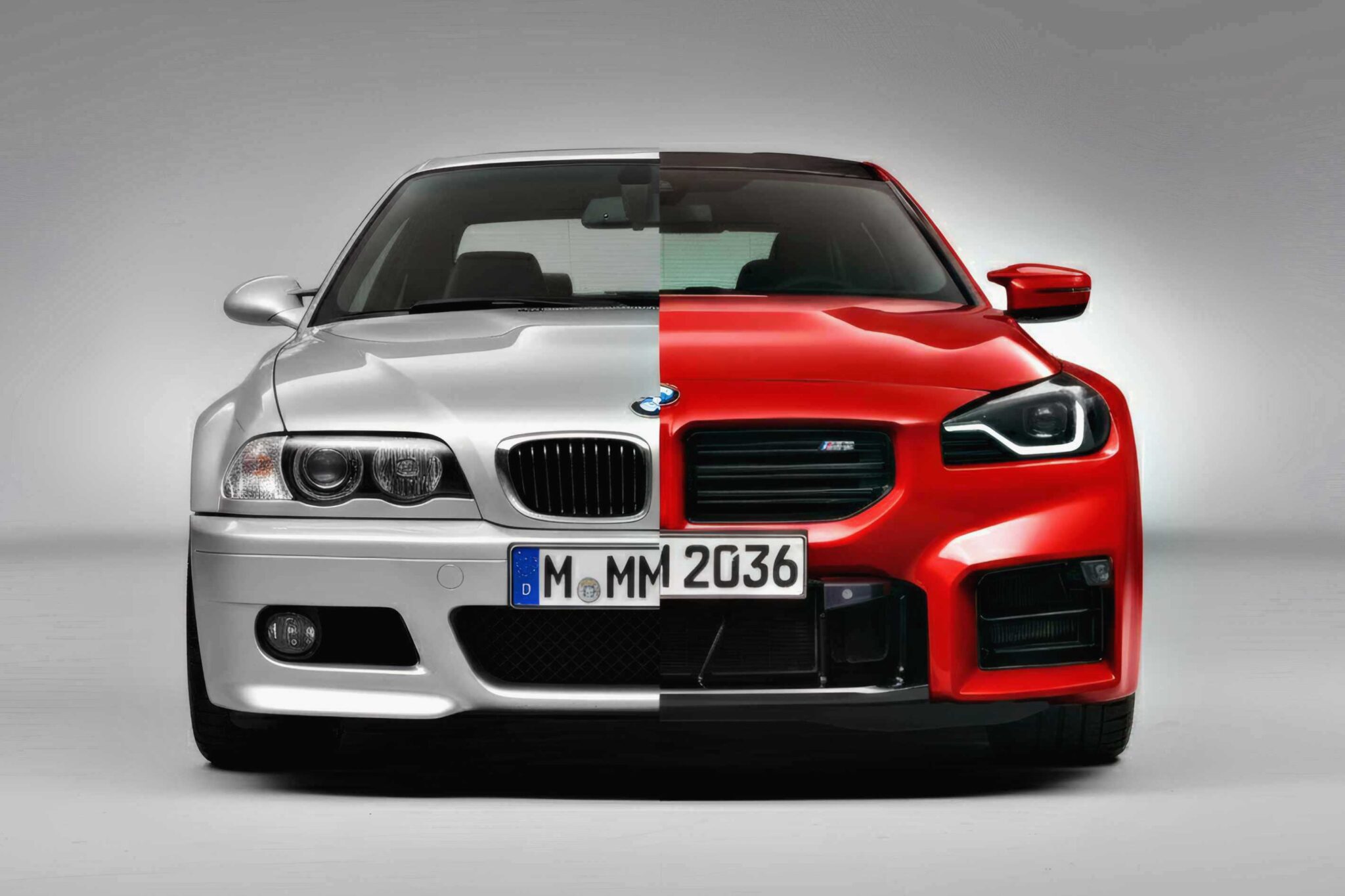
Looking at the modern G80 BMW M3 and G82 BMW M4 models, they are undoubtedly performance powerhouses, although the bold front design (yes, the “beaver face” grille) has sparked endless debate. Over the generations, both cars have become larger, heavier and equipped with more technology than ever before, and in the process they may have lost some of the soul of an old-school compact sports car.
This is a path that most performance models with a long tradition have taken, be it the Porsche 911 or the Chevrolet Corvette. The only outlier without an increase in size is the Mazda MX-5. If you are an enthusiast who wants something from Bavaria but with more compact dimensions and purist character, the BMW M2 G87 is for you.
As Harry Metcalfe of Harry’s Garage recently noted, the M2’s dimensions are strikingly close to those of the legendary E46 BMW M3. Looking at the numbers, the M2 is 180.3 inches long by 74.3 inches wide, while the E46 M3 measures 176.9 inches by 70.1 inches. It’s still not as compact as the E30 BMW M3, but it’s much smaller than the G82 M4.
The current M2 rides on BMW’s CLAR platform (a shortened version shared with the M3 and M4), giving it the same track width as its larger siblings but a narrower wheelbase, which should help it feel livelier on twisty roads.
Under the hood of the M2 is BMW’s twin-turbocharged 3.0-liter S58 inline-six, the same base unit as in the M3 and M4 but boosted to 453 horsepower and 406 pound-feet of torque with the six-speed manual or 443 pound-feet with the automatic. Power is still sent exclusively to the rear wheels, just as it should for an M car. It sprints from 0 to 60 mph in 3.9 seconds with the automatic, 4.1 seconds with the manual, and hits 177 mph if you activate the M Driver’s Package.
With adaptive M suspension, an active differential and massive 15-inch front brakes, the car should be razor-sharp on the road or track. With a curb weight of 3,814 pounds, the G87’s power-to-weight ratio of 8.07 pounds per horsepower significantly exceeds the E46’s 10.0 pounds per horsepower.
The E46 is a front-engine, rear-drive masterpiece that purists still hold in high regard two decades later. The S54 3.2-liter engine in the standard E46 M3 produced 343 horsepower and 269 pound-feet of torque. It remains a front-engine, rear-drive masterpiece that purists still hold in high regard even after two decades. The M3 GTR was the third generation M3 The Hero car from Need for Speed Most Wanted, the figurehead of an entire generation.
Two decades later, the G87 M2 continues to maintain that magical formula: front-engine, rear-wheel drive and three-pedal operation. But long Before the G87 M2 hit the market in 2022, another BMW compact car bridged the gap: the BMW 1 Series M Coupe (the “1M”). Built for just a single model year in 2011, the 1M was BMW’s first real attempt to recreate BMW’s analog thrills in the modern era. It featured a turbocharged 3.0-liter inline-six with 335 horsepower, a six-speed manual transmission and rear-wheel drive only.
Weighing 3,296 pounds, with a ratio of 9.8 pounds per horsepower and a short wheelbase, it was considered wild and edgy. Only 6,309 units were built worldwide, with fewer than 800 built in the United States. Today, clean examples cost between $70,000 and $100,000, often more than they cost new.
The 1M was hard to follow, and the previous generation F87 M2 (2016-2021) carried that torch. It featured a 3.0-liter inline-six producing 370 horsepower and 343 pound-feet of torque. The more powerful version, the M2 CS (F87), produced 444 horsepower from the M4’s S55 engine and weighed just over 3,400 pounds. It is limited to around 2,200 copies and is already selling for almost $100,000 on the used market.
Both the E46 M3 and G87 M2 also spawn hardcore versions that push the performance limits. However, neither the E46 M3 CSL nor the G87 M2 CS offer a manual. The legendary E46 M3 CSL was lighter, sharper and built for the track, with 355 horsepower and 273 pound-feet of torque, its carbon fiber construction making it an icon. The upcoming G87 M2 CS 2026 follows the same formula. Thanks to improvements to the S58 engine, output increases to 523 horsepower and 479 pound-feet of torque.
With its combination of exclusivity, lighter bodywork and sharper response, the M2 CS is likely to be the most track-focused M compact car that BMW has offered to date. It also underlines the M2’s role as the final chapter of a purely rear-wheel-drive, internal combustion engine M car that enthusiasts can still enjoy before the brand moves to hybrid and electric powertrains. Finally, in contrast to the current M3 and M4, the M2 thankfully retains a more timeless, regular-large grille that enthusiasts will appreciate. It is the spiritual successor to the E46 M3 and the 1M. So if you’re chasing classic BMW magic with a dash of nostalgia, the modern M2 is for you. It’s everything you loved about the E46, reborn for today’s world.
| specification | BMW M3 E46 (2001-2006) | 2026 BMW M2 |
| Motor | 3.2L inline-6 naturally aspirated engine (S54) | 3.0L twin-turbo inline-6 (S58) |
| Performance | 343 hp | 453 hp |
| Torque | 269 lb-ft | 406 lb-ft (MT) / 443 lb-ft (AT) |
| transmission | 6-speed manual transmission / SMG | 6-speed manual transmission / 8-speed automatic transmission |
| Drivetrain | Rear wheel drive | Rear wheel drive |
| Curb weight | 3,450 pounds | 3,814 pounds |
| Power-to-weight ratio | 10.2 lb/hp | 8.07 lb/hp |
| 0-60 mph | 4.9 sec | 3.9–4.1 sec |
| Top speed | 155 mph (electronically limited) | 155 mph (177 mph with M Driver Package) |
| length | 176.9 inches | 180.3 inches |
| Width | 70.1 inches | 74.3 inches |
| Height | 54.0 inches | 55.2 inches |
| wheelbase | 107.5 inches | 108.1 inches |
| New RRP | ~$50,000 | $68,200 |
| Used market price (2025) | $45,000-$90,000 and up depending on condition | – |
Images: BMW



