



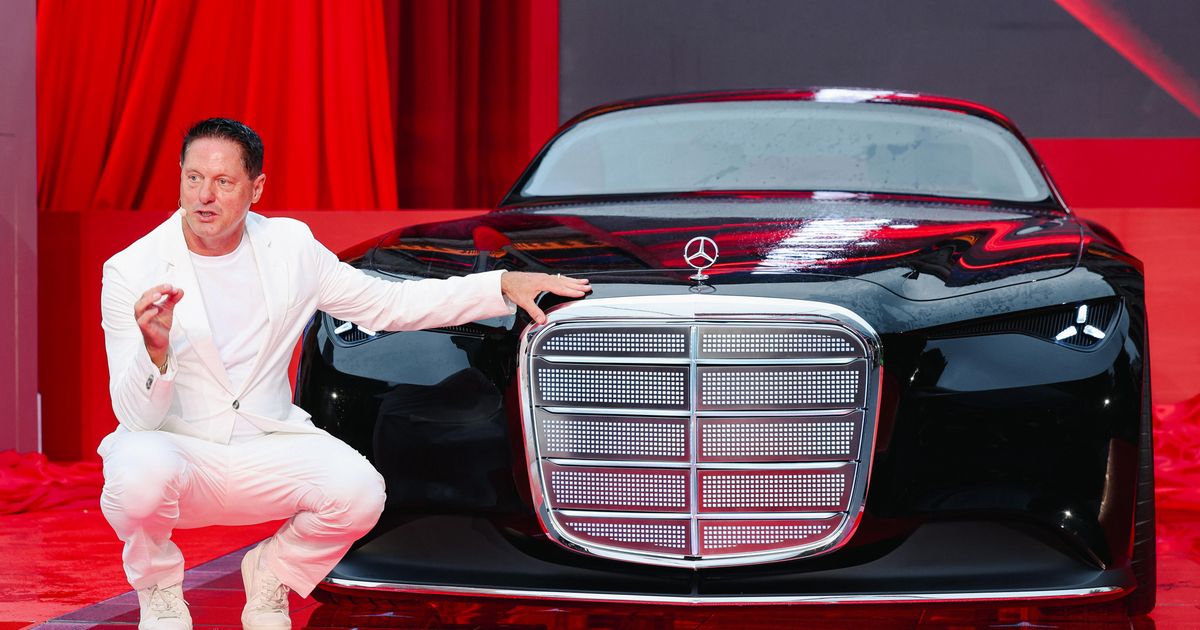
Mercedes Benz Design boss Gordon Wagener has stepped down after nearly a decade in the position and nearly 30 years with the world’s oldest automaker, officially handing over the reins on January 31, 2026.
The German premium car brand confirmed Mr Wagener’s resignation in a statement, saying the 57-year-old made the decision to step down after joining the company in 1997 as a graduate of the Royal College of Art.
Mercedes-AMG design boss Bastian Baudy, 41, takes over as head of design at Mercedes-Benz.
“Now seems to be the right moment to close this chapter and move on to something new,” Mr. Wagener wrote on his Instagram account.
With Daily Sparkz you can save thousands on a new car. Click Here to get a great deal.
“Together we have defined an era – driven by courage, creativity and a radical modernization of design.
“The future for the next decade has already been planned, so I can pass on Mercedes-Benz with confidence.”
Mr Wagener’s resignation comes just days after JLR (Jaguar Land Rover) denied reports that Gerry McGovern had been sacked from his role as chief creative officer, while refusing to confirm his current term.
There have also been recent changes in design leadership at German rivals BMW and Audi: Massimo Frascella was appointed Audi’s chief creative officer in mid-2024.
Mr. Wagener began his career under legendary designer Bruno Sacco, who was responsible for the appearance of Mercedes-Benz models of the late 20th century, including the 190 (W210) and several generations of the S-Class and SL-Class.
His portfolio includes the 2007 Mercedes-Benz SLR McLaren, after which he became the youngest head of design in the brand’s history at just 39 years old.
“Gorden Wagener has shaped the identity of our brands with his visionary design philosophy,” Mercedes-Benz CEO Ola Källenius said in a statement.
“Over many years, he has made a decisive contribution to ensuring that our innovative products are synonymous with unique aesthetics worldwide. His creativity and his feeling for the future of automotive design have enriched Mercedes-Benz in the long term.”
Mr. Wagener introduced a design philosophy he called “sensual purity,” moving Mercedes-Benz away from a conservative era toward a bolder, more contemporary design language.
Unlike many of his predecessors who were trained engineers, including Mr. Sacco, Mr. Wagener studied at the University of Duisburg-Essen before attending the Royal College of Art in London.
He said the approach aimed to produce vehicles that “speak to both the head and the heart” and change the perception of Mercedes-Benz as an “old man’s car.”
The strategy proved successful in attracting younger buyers, with Mr. Wagener responsible for designs such as the A-Class sedan (W176) and the S-Class W222 luxury sedan.
Mr. Wagener also worked on models such as the B-Class, C-Class, E-Class, CLK and the second generation (less polarizing) CLS sedan and CLS station wagon.
The German-born designer led the high-profile designs of the first-generation 2014 Mercedes-AMG GT – a true Porsche 911 competitor – as well as the Formula 1-inspired supercar AMG One and concepts such as the Vision One-Eleven.
He also modernized the growing range of G-Class off-road vehicles and oversaw the introduction of new SUVs, including the GLE-Class and CLC-Class. However, its newer EQE and EQS electric models have drawn criticism and seen sluggish sales in China.
Mr Wagener previously said the EQS sedan, launched in 2021, struggled with marketing and positioning rather than design, claiming it was “ten years too early”.
After negative feedback, Christoph Starzynski, vice president of vehicle development at Mercedes-Benz, said the brand would change its entire design direction towards the 2023 CLA concept.
In response to market feedback and to strengthen brand identity, Mercedes-Benz will now refrain from using a specific design for its electric vehicles with the EQ badge and will instead adopt a consistent design approach for all of its models, whether electric or combustion engine.
Mr Wagener previously criticized Mercedes-Benz’s plans to use artificial intelligence (AI) in vehicle design, arguing that AI-generated concepts were monotonous, boring and annoying.
“It creates 99 percent of s*&$ solutions that are really ugly or weird or off-brand. And yeah, 1 percent of interesting stuff.”
MORE: Discover the Mercedes-Benz showroom



