



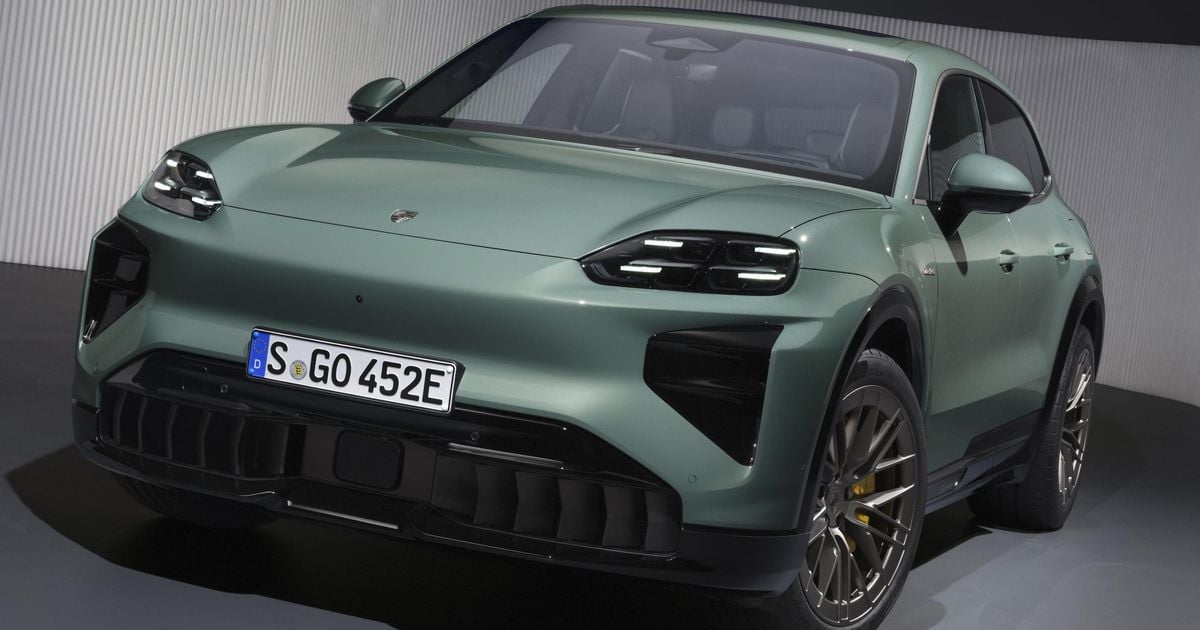
The 2026 Porsche Cayenne Electric is scheduled to launch in Australia in the first half of next year. Prices start at $167,800 (excluding on-road costs), while the fast 850kW flagship Cayenne Electric Turbo costs $259,900 plus on the road.
The Cayenne, which has already established itself as Porsche’s most versatile model, is now going electric, initially in two variants: the Cayenne Electric and the higher performance Cayenne Turbo Electricboth of which were revealed online overnight. Over time, this lineup will expand with the introduction of a sleeker Cayenne Coupe Electric and possibly even more driver-focused variants.
The fourth-generation “E4” Cayenne Electric is only slightly larger than the current large gasoline-powered luxury SUV that continues to be sold (unlike Porsche’s first battery-powered SUV, the Macan Electric, which replaced the original combustion-engined model). It is 5mm longer and measures 4985mm overall, along with a significantly longer wheelbase of 128mm.
Daily Sparkz You can save thousands on a new car. Click Here to get a great deal.
This additional length between the axles is intended to accommodate the 108 kWh lithium-ion battery (usable), which gives the SUV a range of up to 624 km (WLTP).
This will make Porsche’s third electric vehicle (EV) – after the Taycan and Macan – one of the longest range electric vehicles in Australia, behind models such as the new Tesla Model 3 Long Range Rear-Wheel Drive (750km) and the more comparable Polestar 3 Long Range Single Motor (706km).
The new Cayenne EV’s ability to achieve this range is due in part to its exterior design, which has been designed to optimize its aerodynamics without losing the roadside appeal that makes Porsche’s largest SUV so popular.
Unlike the third-generation petrol-powered Cayenne, which will be sold alongside the electric version with updates well after 2030 and features massive air intakes that extend across the front bumper, the Cayenne Electric has a more reserved appearance, with active shutters in the lower section of the front bumper that only open when necessary.
The Cayenne Turbo gets a slightly different front end with contrasting black elements under the LED matrix headlights. The wheels are between 20 and 22 inches in diameter and are designed to look good while helping to increase range efficiency.
Even though the Cayenne takes up a lot of space on the road, clever Porsche engineers have made sure it’s as slippery as possible in the air and used some clever tricks to help it achieve its impressive range.
For example, the now frameless doors feature glass that sits flush with the B-pillar, a design that also minimizes cabin noise at highway speeds, while an active roof spoiler also rises to improve downforce. The Cayenne Turbo Electric gets its own trick: vertically stacked active “aeroblades” that protrude from the rear bumper to reduce drag.
This version also gets a more pronounced rear diffuser with a body-colored center section. Both models have a thin light bar that extends across the entire width of the vehicle, surrounds the rear wing and displays the Porsche logo in individually illuminated letters.
Buyers can choose from an even wider range of options than before when creating more customized specifications, including expanded Paint to Sample colors and the Special Request program, where the only real limit is budget.
Performance plays a key role in the Cayenne Electric’s appeal, and even the base model offers plenty of power thanks to its dual-motor setup. A power output of 300kW gets the electric SUV away from the lights quickly enough, while an overboost function (launch control) increases the power to 325kW, meaning the 0-100km/h sprint takes just 4.8 seconds (claimed). With 835Nm of torque available at all times, this Porsche won’t feel sluggish.
However, it’s the Cayenne Turbo Electric that’s grabbing the headlines with its upgraded engine set, producing 630kW as standard. However, the driver can use the “push-to-pass” button on the steering wheel to gain an additional 130 kW for up to 10 seconds.
But that’s not all: Porsche’s drive engineers have added an overboost function that increases peak power when starting to 850 kW and 1,500 Nm of torque. This means the Cayenne accelerates from 0 to 100 km/h in just 2.5 seconds. As a comparison: the 911 GT3 RS needs 3.2 seconds. Perhaps even wilder is that the Cayenne gets to the finish line in a 0-124 mph race a full second quicker than the latest 911 Turbo S.
However, Porsche would like to point out that this Cayenne isn’t just about going straight fast; It should be great in the corners too. All versions come with Porsche Active Suspension Management (PASM) and adaptive air suspension, which can change both ride height and stiffness.
The Cayenne Turbo Electric is equipped with the Porsche Torque Vectoring Plus (PTV Plus) limited-slip differential on the rear axle, and both models can be ordered with rear-axle steering, which turns the rear wheels by up to five degrees, shortening the turning circle by one meter at low speeds.
There will also be a special off-road package that gives the Cayenne Electric its maximum towing capacity of 3,500 kg. In addition to being fitted with re-profiled bumpers to maximize approach and departure angles, the package allows the Cayenne to rise to a ground clearance of 245mm at up to 35km/h and remain at 215mm at up to 80km/h. It also has a wading depth of 550mm.
While the Cayenne Electric is capable of expending its energy in the form of impressive performance figures, the way it recovers energy and recharges it is almost equally impressive. Thanks to insights from Porsche’s Formula E racing program, the Cayenne Turbo Electric is able to achieve energy recovery of up to 600 kW through its engines.
The forces are so great that engineers estimate that the average driver only uses the friction brakes for three percent of all braking, with the rest coming entirely from the motors sending energy back to the battery.
In addition, the Cayenne Electric has fast charging capability thanks to the 800-volt on-board electrical system architecture. According to Porsche, the maximum DC fast charging power of 400 kW means that the range can be increased by up to 323 km in 10 minutes and that a 10 to 80 percent charge can be achieved on the appropriate charger in 16 minutes.
The Porsche can even draw electricity with up to 200 kW from 400-volt chargers. There are 11kW AC charging ports on each rear wing, and there is the option to upgrade these to 22kW.
Soon after market launch, buyers will be able to charge their Cayenne Electric without a plug. A new wireless charging system is offered, allowing owners to drive via a weatherproof charging pad. As soon as you leave the vehicle, it automatically detects the pad, lowers the car on the air suspension and initiates the charging process. However, the Porsche Wireless Charging (PWC) system has yet to be confirmed for Australia.
Porsche engineers say that while previous efforts in this area have not proven popular or successful, this latest system has almost the same efficiency as plugging into a home wallbox and poses no danger to people or animals below. Its 11kW charging power means that charging times with the system are almost identical to what you would get by connecting via a cable.
The Cayenne Electric’s screen-heavy interior is packed with technology and wrapped in high-quality materials that set Porsche apart from many competitors.
In addition to being one of the few companies that still offers its drivers a perfectly round steering wheel, the company also features a 14.25-inch curved OLED driver instrument display that the owner can configure in a variety of ways, including map navigation front and center.
An additional color head-up display can be added, but the innovative central infotainment touchscreen is sure to turn heads.
Called the Flow Display, this touchscreen curves outward at the base where it meets the center console. Although the diagonal is only 12.5 inches, it looks larger and is supported by what the designers call “Ferry Pad” – a padded resting surface for your hand when you use it.
Wireless smartphone mirroring is possible with Android Auto and Apple CarPlay, and the integration of both functions via the instrument display is better than ever. An additional multimedia touchscreen facing the passenger is available as an option, allowing you to use the infotainment system independently of the center screen.
Rear passengers benefit from generous headroom and legroom, with the outer rear seats offering plenty of support. These are electrically adjustable, including the tilt of the backrest, and there is also temperature control and USB-C ports in the rear.
Continuing the practical theme, the five-seat Cayenne Electric offers a whopping 781 liters of boot space, which can be increased to up to 1,588 liters by folding down the rear seat backs, while the load can be lowered via the air suspension to make loading bulkier items a little easier.
There is also additional storage space under the hood. Simply swipe your hand across the front with the key in your pocket and the bonnet unlocks electrically, which then rises on struts to reveal a further 90 liters of storage space.
The 2026 Porsche Cayenne Electric and Cayenne Turbo Electric are available to order now ahead of delivery to the first Australian customers in the middle of next year.
MORE: Explore the Porsche Cayenne showroom



