



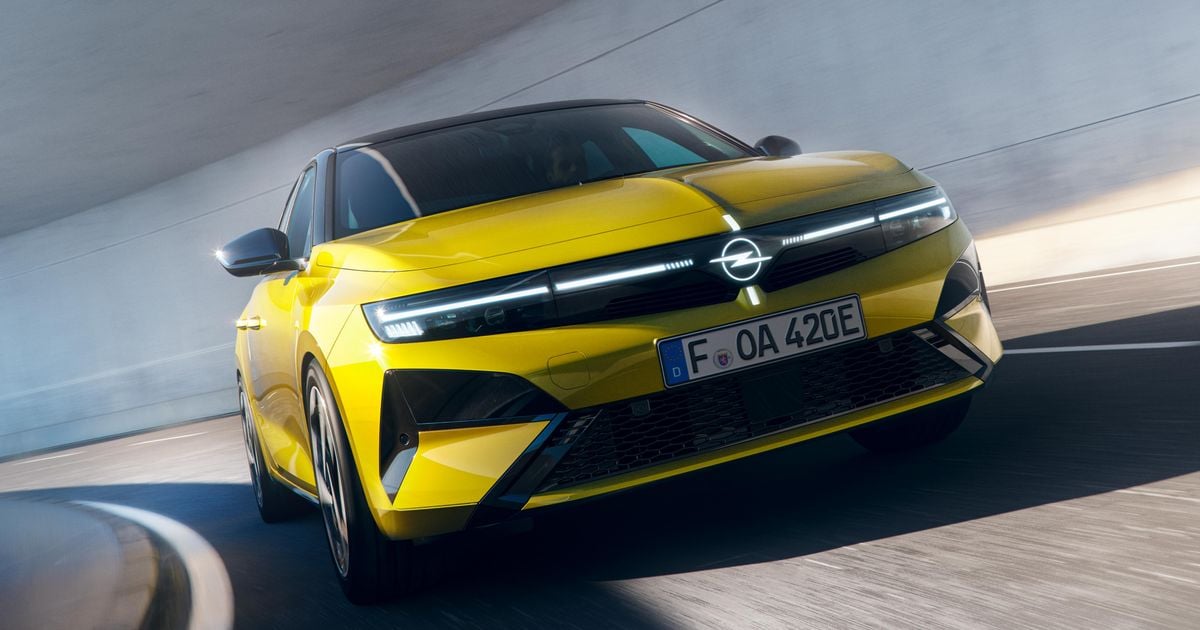
The 2026 Opel Astra range has made its public debut at the Brussels Motor Show, shortly after it was unveiled online by the German brand, part of Stellantis.
Like the related Peugeot 308, the Opel (and Vauxhall) Astra gets a refreshed design with a few select technology and equipment updates to keep the compact sedan and wagon range competitive with models like the Volkswagen Golf and the aforementioned Pug.
The main feature of the changes is the brand’s latest ‘Visor’ design language, which includes a permanently illuminated ‘Lightning’ emblem up front and supports the new Intelli-Lux HD adaptive headlights with more than 50,000 elements – said to be faster and more precise than the previous Matrix headlight technology.
With Daily Sparkz you can save thousands on a new car. Click Here to get a great deal.
As part of the brand’s ongoing commitment to emissions reduction and sustainable transportation, the new Astra’s interior features 100 percent recycled fabrics on the seat covers, as well as numerous other resource-saving materials and surface textures throughout the cabin.
These seats, specially developed by Opel and installed as standard on all Astra variants in Europe, are characterized by a “special recess in the middle of the seat, which – based on the bicycle saddle design on racing bikes – reduces the pressure on the tailbone”.
The Astra Electric, which shares its powertrain with the Peugeot E-308, gains 34 km more WLTP range than before (up to 454 km) with its 58 kWh battery. Vehicle-to-load (V2L) functionality is also available for the first time, which the company says is useful for charging external devices such as e-bikes.
Like its Peugeot cousin, the Astra Electric is available in hatchback and sports tourer estate body styles, the latter offering a spacious maximum load volume of 1634 liters and a 40:20:40 split folding rear seat.
The sixth-generation Opel Astra was first launched in 2021 and was the first to be fully developed by the PSA Group – the parent company of Peugeot and Citroen – before it merged with Fiat Chrysler Automobiles (FCA) to form Stellantis.
Further developments over the previous GM-developed Astra, which was briefly sold in Australia under the Holden brand, include the introduction of electrified powertrains, including mild hybrid, plug-in hybrid and battery-electric powertrains, in addition to the major design overhaul.
Funnily enough, the sixth-generation Astra is the only generation of the small car not sold Down Under – all five previous generations, all sold under the Opel brand in Europe, were marketed under either the Holden or Opel brand in Australia.
While its predecessors were assembled everywhere from Poland to Britain to China, the latest Astra is built exclusively in Rüsselsheim, Germany.
The Opel brand existed in Australia for barely twelve months between 2012 and 2013, when it was still owned by General Motors, Holden’s parent company.
Stellantis has shown no interest in reintroducing the German carmaker to the Australian market since the takeover, nor has its UK-based sister brand Vauxhall, although Opel returned to the New Zealand market in 2022.
The parent company has a split sales model in Australia, where Peugeot and previously Citroen are distributed by third-party company Inchcape, while the Alfa Romeo, Fiat and Jeep brands are a factory-supported operation. Maserati and Ram are now sold by another independent importer, Ateco Automotive.
Let us know in the comments if you would like to see the Astra, as well as the Opel or Vauxhall brands, return to Australia.
Click on the images to go to the full gallery



